📖 Stars Cannot Form Themselves: The Jeans Problem, Dark Matter, and the Circular Logic of Stellar Nucleosynthesis
TypeScience Apologetics Reference — Star Formation and Stellar Nucleosynthesis
Central ClaimThe spontaneous formation of stars from interstellar gas is physically prohibited by the Jeans instability, the angular momentum barrier, and magnetic field resistance. The secular model patches these problems with unobserved dark matter whose existence depends on the Big Bang being true. Population III stars, the model's required first-generation objects, have never been found. And the nucleosynthesis of elements heavier than iron requires supernovae, which require stars that formed, making the entire chain of reasoning circular from its foundation. Biblical creation resolves all of these problems simultaneously by the simplest possible mechanism: God made the stars.
"He made the stars also." — Genesis 1:16
"He determines the number of the stars; he gives to all of them their names." — Psalm 147:4
"Where were you when I laid the foundation of the earth? Tell me, if you have understanding. Who set its measurements? Surely you know! Or who stretched the line on it? On what were its bases sunk, or who laid its cornerstone, when the morning stars sang together and all the sons of God shouted for joy?" — Job 38:4–7
The Secular Claim
The standard secular account of stellar origins goes like this: after the Big Bang, the universe consisted of hydrogen and helium gas. Over millions of years, gravity caused this gas to clump. Eventually dense enough regions collapsed to form the first stars. Those stars lived, died in supernovae, and scattered heavy elements into space. New stars formed from that enriched gas. The process continues today.
This narrative is presented in textbooks as settled science. It is not. At every step, the physics resists the story. What follows is a careful examination of why.
Part I: The Physics of Why Gas Clouds Do Not Collapse into Stars
The Jeans Instability
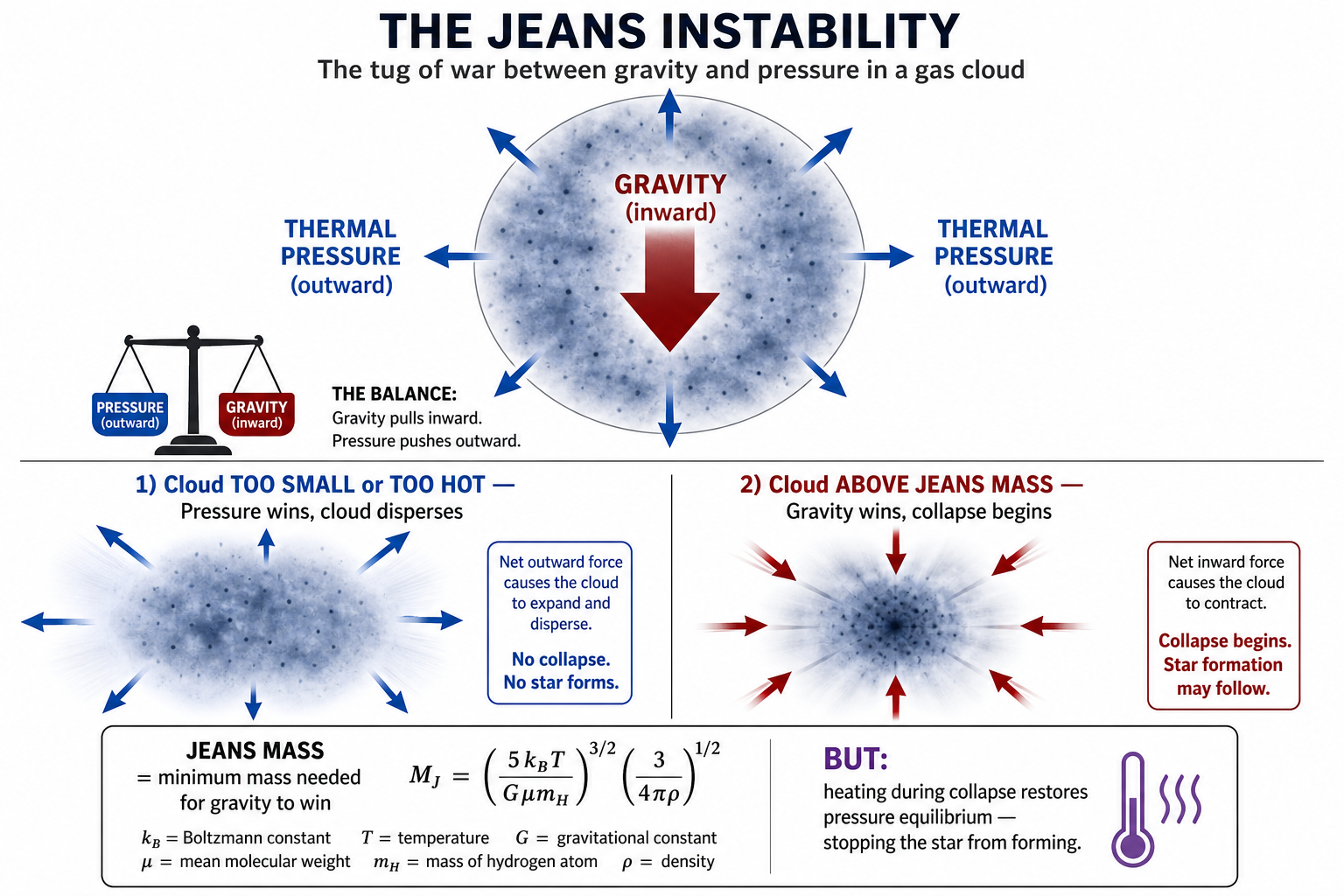
The Jeans Instability: gravity (inward) vs. thermal pressure (outward). A cloud below the Jeans mass disperses; one above it begins to collapse. But collapse itself heats the gas, restoring outward pressure and stopping the star from forming.
In 1902, physicist Sir James Jeans derived the conditions under which a cloud of gas can collapse under its own gravity rather than being held up by internal pressure. The key relationship is between gravitational force (which pulls the cloud inward) and thermal pressure (which pushes outward).
For any gas cloud to collapse and form a star, it must satisfy two conditions simultaneously:
- It must exceed the Jeans mass: the minimum mass above which gravity overcomes thermal pressure
- It must be smaller than the Jeans length: the maximum radius within which the collapse time is shorter than the sound-crossing time
The Jeans mass for a typical cold interstellar cloud (temperature around 10 K, density around 10,000 hydrogen molecules per cubic centimetre) works out to approximately 1 to 10 solar masses. On its face, this seems to suggest collapse should be possible. The fatal problem arises the moment the collapse begins.
Boyle's Law and the Heating Problem
When a gas is compressed, it heats up. This is not a side effect; it is fundamental to the behaviour of gases. Boyle's Law and the ideal gas law (PV = nRT) state that for a fixed quantity of gas, pressure and temperature rise together as volume decreases.
As a gas cloud begins to collapse under gravity, the density increases. The increasing density causes the temperature to rise. The rising temperature causes the pressure to increase. The increased pressure resists further collapse. This is called an adiabatic response, and it is precisely what prevents ordinary gas clouds from collapsing into stars.
For collapse to continue, the cloud must radiate away the heat faster than compression generates it. This requires an efficient cooling mechanism. In the early universe, before any stars existed, the only available coolants were molecular hydrogen (H₂) and a small amount of lithium hydride. These are extremely inefficient coolants compared to the metal-line cooling available in later generations of star formation. This is why secular models predict the first stars should have been enormous (100 to 1,000 solar masses) and formed very slowly, if at all.
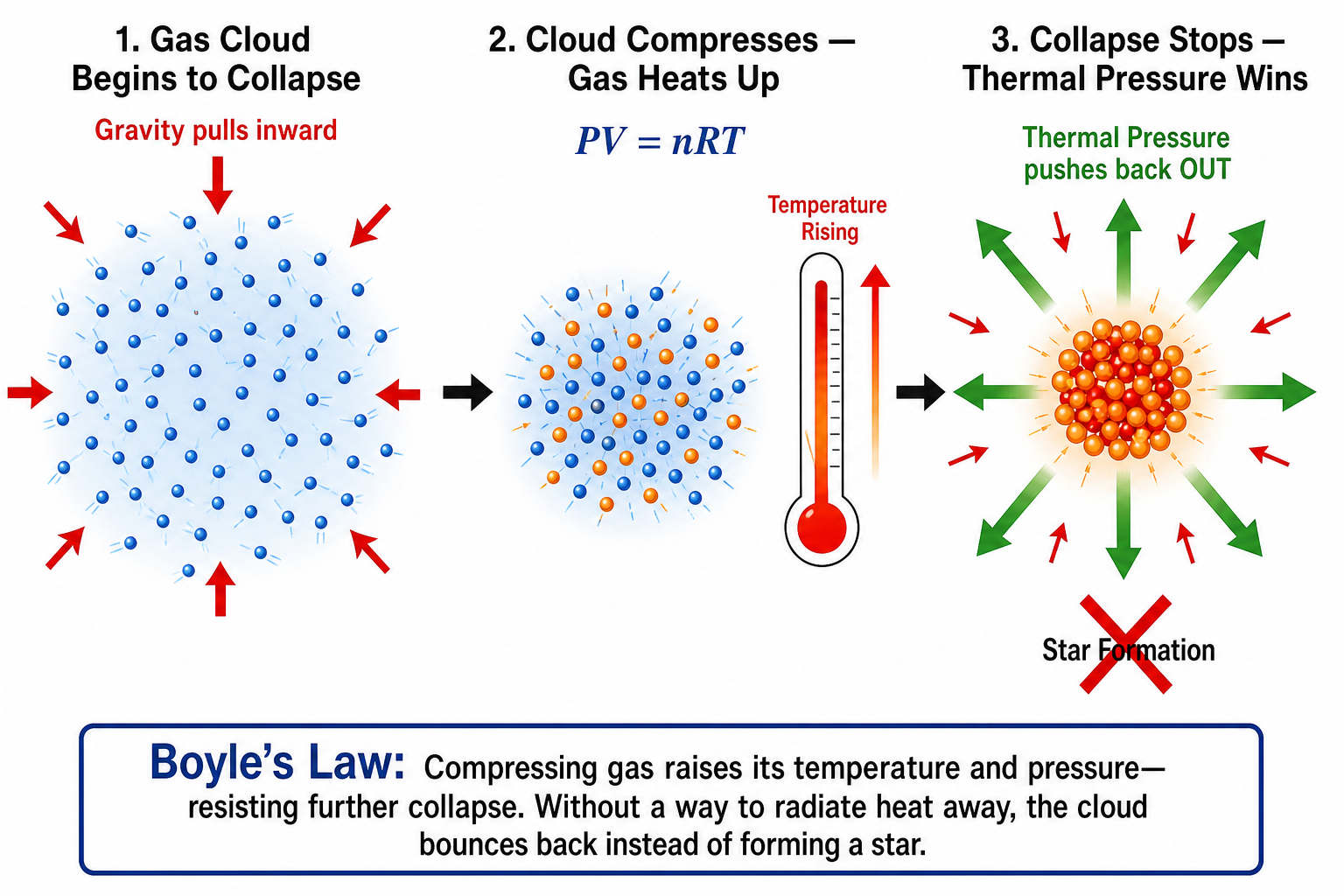
Three stages of a collapsing gas cloud. Gravity pulls inward (red arrows), but compression heats the gas (PV = nRT), raising thermal pressure (green arrows) until it overpowers gravity and halts the collapse. Without a mechanism to radiate away that heat, no star forms.
A collapsing gas cloud heats up as it shrinks. Without an efficient way to radiate away that heat, thermal pressure halts the collapse before a star forms. This is not a minor obstacle; it is what the laws of thermodynamics require.
The Angular Momentum Problem
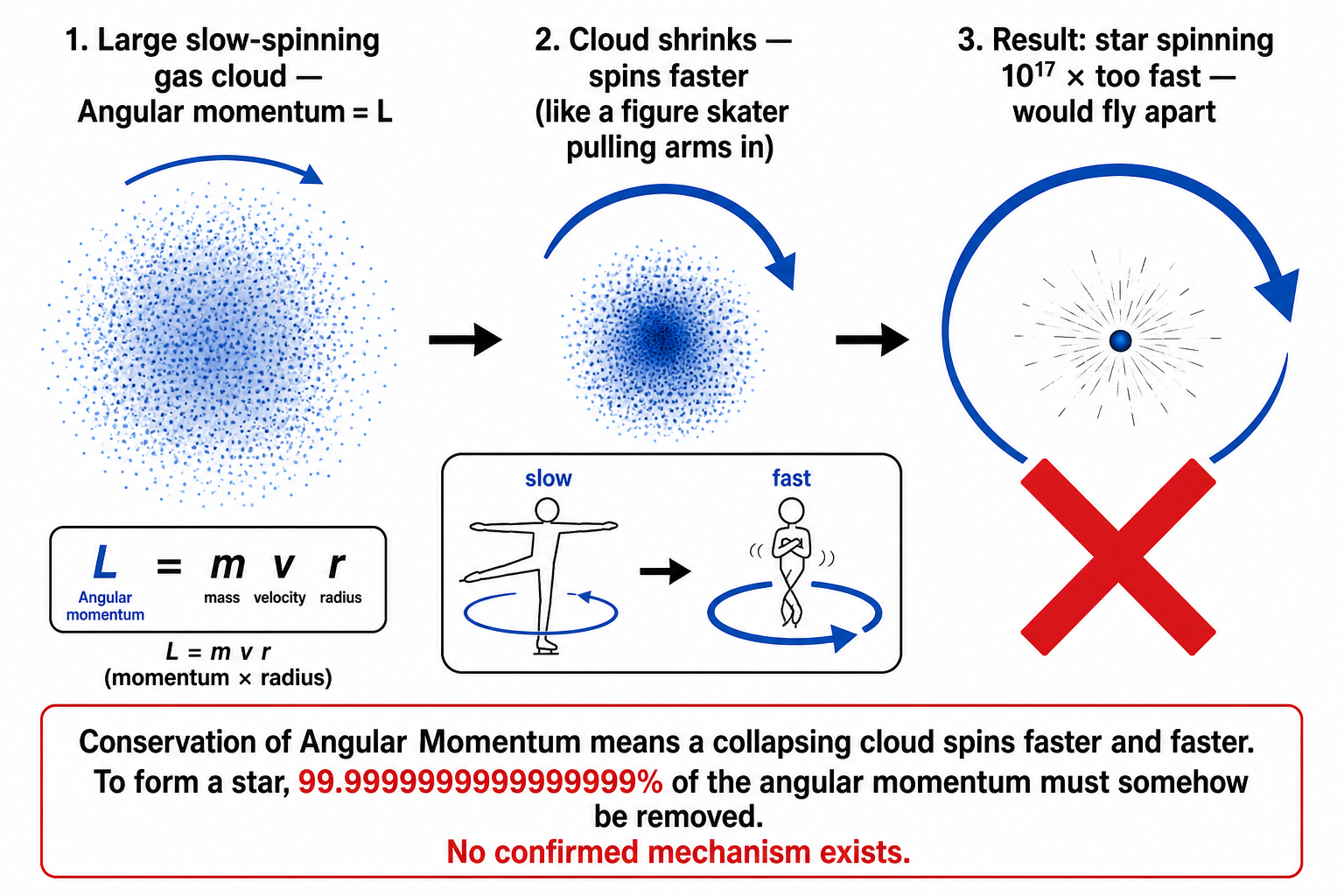
A large slow-spinning cloud collapses and spins faster as its radius shrinks, exactly like a figure skater pulling in their arms. By the time the cloud has contracted to stellar size, it would be spinning 10¹⁷ times too fast to hold together. No confirmed mechanism exists to remove that much angular momentum.
Every gas cloud in the universe is rotating, even if only slightly. As a rotating cloud collapses and its radius decreases, its rotation rate must increase dramatically. This is the same physics that causes a figure skater to spin faster when pulling in their arms: conservation of angular momentum.
The angular momentum of the gas in a typical molecular cloud is enormously larger than the angular momentum of any known star. If a cloud collapsed into a single star while conserving angular momentum, the star would be spinning so fast that centrifugal force would tear it apart before it could form. The ratio of cloud angular momentum to stellar angular momentum is roughly 10¹⁷: seventeen orders of magnitude must be shed for a star to form.
Secular models invoke processes like magnetic braking, turbulent viscosity, and binary star formation to shed this angular momentum. None of these mechanisms have been demonstrated to operate at the required efficiency in the required timeframe. The problem has been known since the 1970s and remains, in the words of secular astrophysicist Frank Shu, "the central unsolved problem in star formation theory."
The Magnetic Field Problem
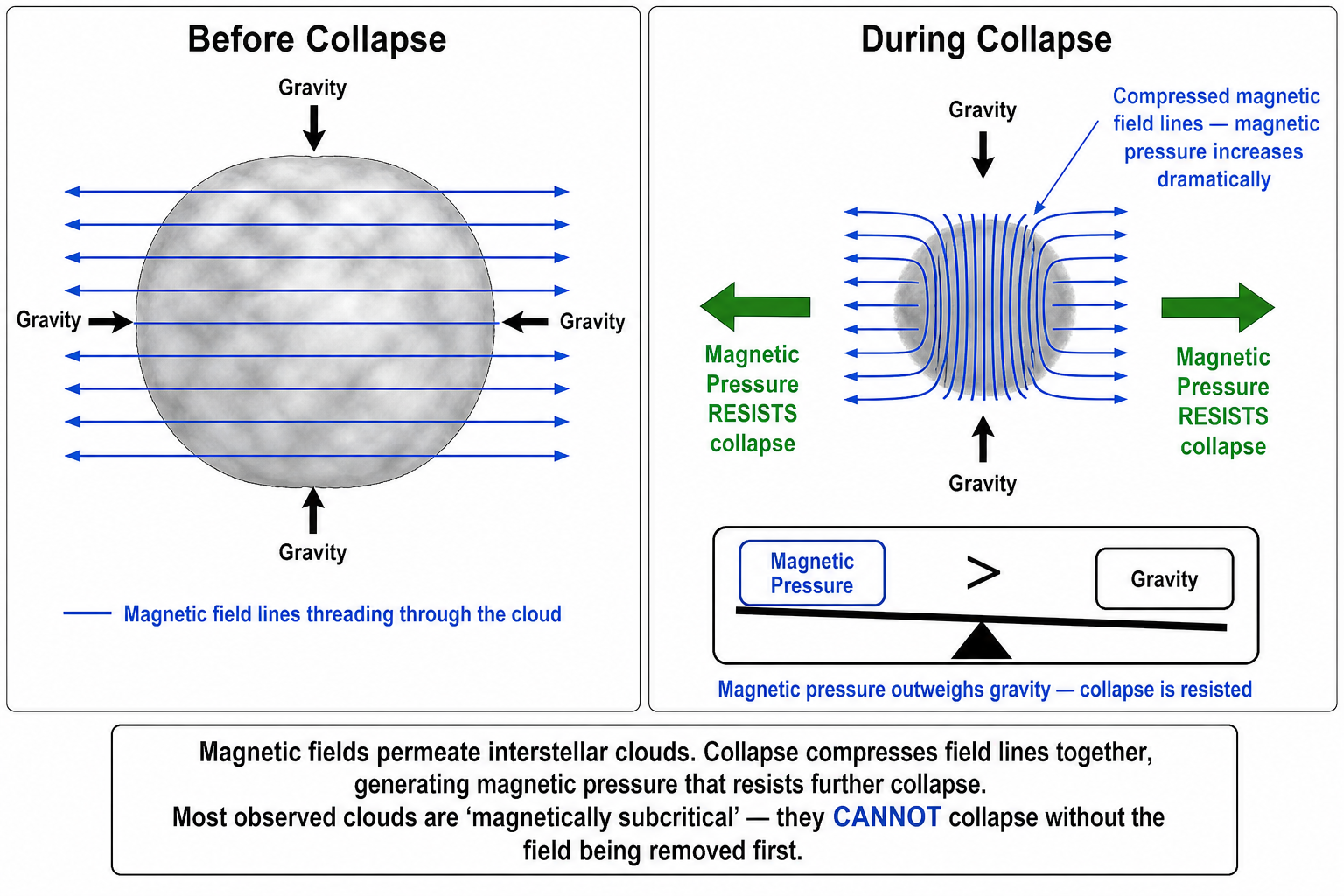
Before collapse, magnetic field lines thread evenly through a gas cloud. During collapse, those lines are compressed together, dramatically increasing magnetic pressure outward. Most observed interstellar clouds are "magnetically subcritical" — magnetic pressure alone is strong enough to prevent gravitational collapse.
Interstellar gas clouds are threaded with magnetic fields. As a cloud collapses, the magnetic field lines are compressed together. Compressed magnetic fields exert a pressure called magnetic pressure, which resists collapse just as thermal pressure does.
Most observed molecular clouds in the Milky Way are what astronomers call magnetically subcritical: the magnetic pressure is strong enough to prevent gravitational collapse even without any thermal support. For these clouds to form stars, the magnetic fields must be removed or weakened first, a process called ambipolar diffusion, in which ions slowly drift relative to neutral molecules, dragging the field lines out of the collapsing region.
Ambipolar diffusion operates on timescales of tens of millions of years under ideal conditions. It requires specific density conditions that are not universally present. It is another unobserved, theoretically required mechanism that secular star formation models depend upon without direct confirmation.
Part II: Dark Matter as the Load-Bearing Assumption
What Dark Matter Does for Star Formation
The secular model does not merely propose that stars formed spontaneously from primordial gas. It requires that dark matter provided the gravitational scaffolding. The proposal is:
- Dark matter clumped first, because it does not interact with radiation and therefore does not experience the thermal pressure that prevents ordinary matter from collapsing
- These dark matter halos created deep gravitational wells
- Ordinary hydrogen and helium gas fell into these wells, becoming dense enough to overcome the Jeans instability and cool efficiently
- Stars then formed inside these dark matter halos
Without dark matter, the primordial gas in the early universe was far too diffuse and too hot to form stars by any known physical process. The entire first-generation star formation story depends on dark matter being real, present in the right amounts, and distributed in the right way.
Dark Matter Has Never Been Directly Detected
Despite decades of searching, dark matter has never been directly observed. No laboratory experiment has detected a dark matter particle. The Large Hadron Collider has not produced one. Dedicated direct-detection experiments (LUX, XENON1T, PandaX) have found nothing. Indirect detection experiments searching for annihilation signals have produced no confirmed detections.
Dark matter is inferred entirely from its gravitational effects: the rotation curves of galaxies, gravitational lensing, and the CMB power spectrum. All of these inferences assume the Big Bang model as their interpretive framework. If the Big Bang model is false, the evidence for dark matter dissolves with it: the anomalous rotation curves and lensing effects may have alternative explanations, and the CMB power spectrum is model-dependent.
The point is not that dark matter definitely does not exist. The point is that the existence of dark matter is an inference within the Big Bang framework. If that framework is wrong, dark matter is not independently established. And if dark matter does not exist, there is no known physical mechanism by which the first stars could have formed at all.
Star formation in the early universe requires dark matter to provide the gravitational trigger that ordinary physics cannot. Dark matter has never been directly detected and its existence is inferred within the very cosmological framework whose validity is in question.
Part III: Population III Stars — Predicted for Decades, Never Found
What They Should Be
The Big Bang predicts that the first generation of stars, designated Population III, formed from pristine gas containing only hydrogen, helium, and trace lithium. They contained no metals whatsoever: no carbon, no oxygen, no silicon, no iron. Because metal-line cooling was unavailable, these stars should have been very massive, perhaps 100 to 1,000 times the mass of the Sun, and should have lived only a few million years before exploding as supernovae and seeding the universe with the first metals.
These stars are a critical load-bearing element of the secular story. Without them, there is no source for the first heavy elements. Without heavy elements, the next generation of stars cannot form efficiently. The entire chain of stellar and chemical evolution in the universe depends on Population III stars having existed in vast numbers in the early universe.
What JWST Found Instead
The James Webb Space Telescope was designed in part to detect Population III stars or their signatures in the most distant, earliest galaxies. The prediction was clear: the deepest, highest-redshift galaxies should be metal-poor, possibly metal-free, with signatures of those first massive stars.
Every high-redshift galaxy JWST has examined contains metals. Oxygen, carbon, nitrogen, and other heavy elements are present in galaxies at redshifts above 10, in the epoch when Population III stars should still be the dominant stellar population. The metallicity range at high redshift is comparable to that of nearby galaxies (Rhoads et al. 2023). There is no metal-free population. There are no confirmed Population III stars.
As Dr. Jason Lisle predicted in 2024: "We will not find galaxies full of the long-sought-after Population III stars. Biblically, heavy elements like oxygen preceded the creation of the stars since water existed on Day 1 but stars were made on Day 4." The JWST is confirming this prediction year by year.
The secular response is to push Population III star formation to ever earlier times, beyond current detection capability. This is the same pattern seen with galaxy evolution: every time JWST finds something that contradicts the model, the model is adjusted to push the required event earlier and earlier, beyond the reach of current instruments.
The Big Bang predicted metal-free Population III stars should be abundant in the early universe. JWST finds metals everywhere it looks, at every redshift. Population III stars remain entirely hypothetical after twenty years of searching with the most powerful telescopes ever built.
Part IV: Nucleosynthesis and the Iron Ceiling
How Stars Build Elements Up to Iron
Inside stars, nuclear fusion converts lighter elements into heavier ones, releasing energy in the process. The sequence proceeds through a series of burning stages in massive stars:
- Hydrogen burning: four hydrogen nuclei fuse into one helium nucleus (the main sequence lifetime of a star, lasting billions of years in Sun-like stars)
- Helium burning: three helium nuclei fuse into one carbon nucleus; helium and carbon fuse to form oxygen
- Carbon burning: two carbon nuclei produce magnesium, sodium, neon, and oxygen
- Neon burning: neon nuclei are photodisintegrated and rearranged, producing magnesium and oxygen
- Oxygen burning: two oxygen nuclei produce silicon, sulfur, phosphorus, and magnesium
- Silicon burning: a rapid sequence of reactions converts silicon into iron, nickel, and cobalt
Each of these burning stages releases energy because the products have lower total mass than the reactants. The mass difference is released as energy (E = mc²). This continues until the process reaches iron.
The Iron Ceiling: Why Stars Stop at Iron
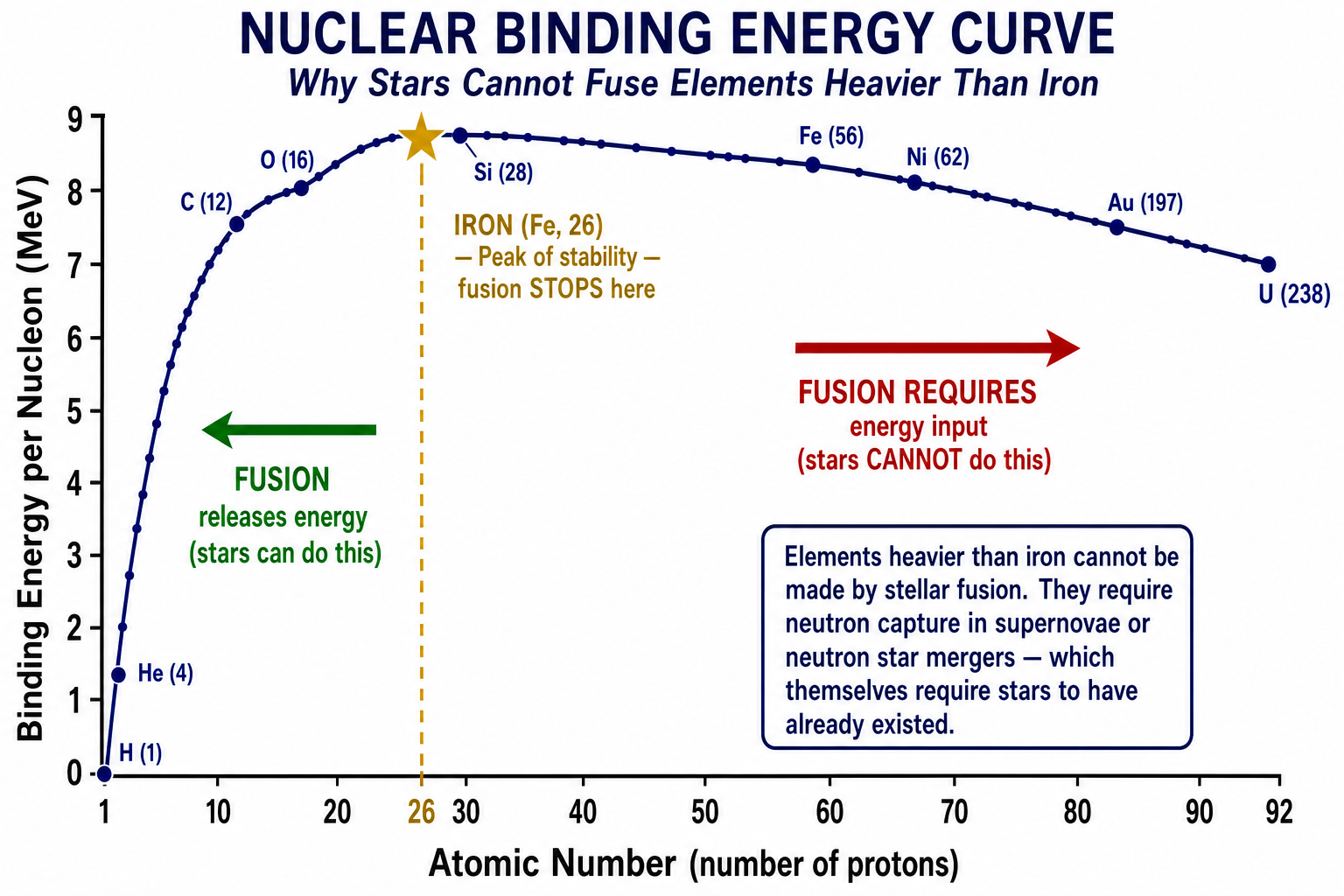
The nuclear binding energy curve. Fusion releases energy on the left side of the iron peak (green arrow) — this is what powers stars. Past iron (element 26, gold star), fusion requires energy input rather than releasing it (red arrow). Stars accumulate iron in their cores until fusion stops entirely, triggering collapse. Gold, uranium, and all other heavy elements cannot be made this way.
Iron (element 26, ²⁶Fe) sits at the peak of the nuclear binding energy curve. It has the highest binding energy per nucleon of any element. This means that fusing iron nuclei together does not release energy; it requires energy input. There is no energy payoff for burning iron.
The moment a massive star accumulates an iron core, nuclear burning ceases. The core can no longer generate outward radiation pressure to support itself against gravity. The collapse is catastrophic and rapid, occurring in less than one second, producing either a neutron star or a black hole. The outer layers are ejected in a Type II supernova.
The result: stars can produce all elements from hydrogen through iron by fusion. They cannot produce any element heavier than iron by fusion. The periodic table contains 92 naturally occurring elements. Iron is element 26. Stars cannot make the other 66 by stellar nucleosynthesis.
Elements Heavier Than Iron: The r-Process and s-Process
Elements heavier than iron are produced by neutron capture: a nucleus absorbs a free neutron, becomes unstable, and undergoes beta decay (a neutron becomes a proton, moving the atom one element higher). Two processes accomplish this:
The s-process (slow neutron capture): operates in AGB (asymptotic giant branch) stars over thousands of years, producing elements up to bismuth (element 83). Products include strontium, barium, and lead.
The r-process (rapid neutron capture): requires an extreme neutron flux operating on millisecond timescales. The required conditions are found in:
- Neutron star mergers (confirmed by the 2017 LIGO/Virgo detection of GW170817 and its associated kilonova AT2017gfo)
- Core-collapse supernova interiors (still debated as a significant r-process site)
- Possibly magnetar wind nebulae
The r-process produces gold, platinum, uranium, thorium, and virtually all elements above bismuth.
The List of Reasons Heavier-Than-Iron Elements Cannot Come From Stars Alone
The following are the established physical barriers:
- Iron is the fusion endpoint. No element heavier than nickel-56 (which decays to iron-56) is produced by stellar fusion. The binding energy curve prohibits it.
- The s-process requires pre-existing seed nuclei. The s-process in AGB stars begins from iron-peak seed nuclei. It cannot operate without iron already present, which requires earlier generations of stars.
- The r-process requires extreme neutron density. Free neutron densities of 10²⁴ per cubic centimetre are required for the r-process. This condition is not reached inside normal stars at any stage of their evolution.
- Neutron star mergers require prior stellar evolution. A neutron star merger (a kilonova) requires two neutron stars in a binary system. Each neutron star is the remnant of a massive star that went supernova. There can be no neutron star merger without multiple prior generations of massive stars having formed, lived, and died.
- Supernova r-process is uncertain. Whether core-collapse supernovae are significant r-process sites remains actively debated. Many simulations fail to reproduce the required neutron flux conditions. Kilonova observations (GW170817) confirm neutron star mergers as the primary r-process site, but this requires multiple stellar generations to have already occurred.
- Timescales are prohibitive in the early universe. Neutron star mergers require billions of years to inspiral to merger. They cannot have produced the heavy elements observed at high redshifts without assuming the universe is billions of years old, which assumes the very Big Bang timeline under examination.
Part V: The Circular Reasoning at the Foundation of Stellar Evolution
The secular account of star formation and nucleosynthesis is not a linear chain of events. It is a circle. Each step requires the previous step to have already occurred:
Step 1: Primordial gas (hydrogen and helium) must form the first stars. Problem: Gas cannot cool efficiently without metals. Cooling requires carbon, oxygen, and other metal-line emitters. Metals do not exist yet.
Step 2: Dark matter halos provide the gravitational trigger to form first stars despite the cooling problem. Problem: Dark matter has never been directly detected. Its existence is inferred within the Big Bang framework. If the framework is wrong, dark matter is not established.
Step 3: Population III stars form, live briefly, and explode as supernovae, seeding the universe with the first metals. Problem: Population III stars have never been observed. JWST finds metals in the earliest accessible galaxies, which is what creation science predicts and what the Big Bang model did not predict.
Step 4: Second-generation stars form from metal-enriched gas, forming more efficiently due to metal-line cooling. Problem: This step still requires the first step to have succeeded. But Step 1 has no confirmed physical mechanism.
Step 5: Heavy elements above iron are produced by supernovae and neutron star mergers. Problem: These events require prior stellar generations. Neutron star mergers require billions of years of binary evolution. The elements observed at high redshift cannot have been produced by this pathway in the available time without presupposing the Big Bang's timeline.
The foundation of the entire edifice is a star formation event that violates three independent physical laws simultaneously: the Jeans instability (thermal pressure), angular momentum conservation, and magnetic field pressure. The solutions to each of these barriers are unobserved mechanisms (dark matter halos, ambipolar diffusion, angular momentum transfer) that are assumed to have operated as required by the model they are invoked to rescue.
The secular star formation story requires that the first stars formed without metals, without an efficient cooling mechanism, against the Jeans instability, while shedding 10¹⁷ times their angular momentum, and through a gravitational trigger provided by undetected dark matter. Every one of these requirements is unobserved. Every one is assumed because the model requires it.
Part VI: The Biblical Response — God Made the Stars
"And God made the two great lights, the greater light to rule the day and the lesser light to rule the night. He made the stars also." — Genesis 1:16
The text is as brief as it is decisive. The stars are not products of a natural process initiated billions of years ago. They are the work of God, spoken into existence on Day 4 of Creation Week alongside the sun and moon.
This is not a primitive claim made in ignorance of physics. It is a claim that resolves every problem catalogued above:
On the Jeans instability: The barrier does not apply because stars did not form by gravitational collapse. God created them fully formed, functioning from the first moment of their existence. This is the same pattern seen throughout creation: Adam was created as a mature adult (Genesis 2:7), not as a fertilised embryo left to develop. The creation was complete at the moment it was made.
On angular momentum: A directly created star carries no history of cloud collapse. The rotational properties of stars today reflect their created initial conditions, not the residual spin of a contracting gas cloud that never actually existed.
On heavy elements at high redshift: Genesis records that water (H₂O) existed on Day 1 before any star was created (Genesis 1:2). Water contains oxygen. Hydrogen and oxygen were present in the universe from its first moment, not as a product of stellar generations. The presence of metals in the earliest galaxies JWST observes is not a problem for creation; it is exactly what creation predicts.
On Population III stars: They have never been found because the universe was never in the metal-free state the Big Bang requires. The starting conditions of the cosmos were not a pristine hydrogen plasma but the creation described in Genesis, which included the chemical richness required for a functioning, life-supporting cosmos from the beginning.
On nucleosynthesis: The elements of the periodic table are part of the created order. God did not need seventeen successive generations of supernovae to manufacture gold. He created it. This is not experimentally testable, but the secular claim that 13.8 billion years of stellar evolution produced it is equally untestable by experimental science. Both are origins claims. Origins science reconstructs the past from present evidence; it does not observe origins directly. The comparison is between two interpretive frameworks, not between science and non-science.
"By faith we understand that the universe was created by the word of God, so that what is seen was not made out of things that are visible." — Hebrews 11:3
Biblical creation does not need to overcome the Jeans instability, the angular momentum barrier, or the magnetic field barrier, because it does not claim stars formed by natural gas collapse. God made the stars directly, fully formed, chemically complete, on Day 4. The problems documented in this article are problems for naturalism, not for creation.
A Note on Intellectual Honesty
Stating that God created the stars is not the end of inquiry. It is the beginning.
Saying "God did it" as a conversation-stopper is the same logical move the naturalist makes when invoking "given enough time" to dissolve every problem. Both are arguments from an assumed framework, not arguments from evidence. We should not mirror that move.
The command to love God with all our mind (Matthew 22:37) means we are obligated to press further: What did he make? How does it work? What does it reveal about his character, his power, and his purposes? The creation is not a locked box; it is a record, and God scattered testimony throughout it for those willing to read it carefully.
What this document argues is narrower: the naturalist account of first-generation star formation is physically incoherent on its own terms. The evidence does not point toward a self-assembling cosmos. It points toward a cosmos that was assembled. The question of who assembled it, and how, is exactly the kind of question science and theology are both equipped to pursue, each in their proper domain.
Part VII: Common Objections and Responses
Objection: "We observe star formation happening right now in nebulae like the Orion Nebula. This proves stars form naturally."
Response: What we actually observe in regions like the Orion Nebula are dense, structured gas clouds and proto-stellar blobs. Whether any given object will actually become a star is an inference, not an observation. Many of the bright compact knots catalogued in these regions are protostellar candidates, not confirmed stars in formation, and some show no clear sign of ongoing collapse at all. More importantly, these regions are already enormously metal-enriched, embedded in environments shaped by many prior stellar generations, and in most cases the compression is being triggered externally by shockwaves from nearby supernovae. None of that applies to the formation of the universe's first stars from pristine metal-free primordial gas. Pointing to the Orion Nebula as evidence for first-generation star formation is like pointing to a fully equipped automotive factory as evidence that the first machine tools built themselves from raw ore.
Objection: "Computer simulations successfully model star formation."
Response: Computer simulations model the inputs their programmers assume. Every simulation of first-generation star formation assumes: dark matter halos, specific initial density fluctuations, specific cooling functions, and initial conditions calibrated to match the desired outcome. When the simulation produces stars, it demonstrates that under those assumed conditions, the math produces that result. It does not demonstrate that those conditions actually existed or that the physical processes assumed actually operated as modelled. A simulation is only as reliable as its assumptions, and the assumptions here are precisely what is in question.
Objection: "We know neutron star mergers produce gold because we detected gravitational waves from GW170817."
Response: The 2017 detection of GW170817 and its kilonova AT2017gfo is genuinely significant and does confirm that neutron star mergers produce heavy r-process elements including gold and platinum. This is excellent observational science and is not disputed here. What it does not establish is that this process can account for the heavy elements observed in galaxies at redshifts above 10. Those galaxies would need to have formed stars, produced neutron stars, had those neutron stars evolve in binary pairs, and merged, all within the available time window implied by the Big Bang. The timescales are deeply problematic, and the observed metallicity at high redshifts remains unexplained within the standard model.
Objection: "Creationists cannot explain where heavy elements came from if God created everything from hydrogen."
Response: This objection assumes that creation began with hydrogen and then required a natural process to produce heavier elements, which is not what Genesis says. Genesis does not say God created hydrogen and then waited. It says God created the heavens and the earth, with water present on Day 1. Water is H₂O; oxygen is already present. The created order from Day 1 included chemical complexity. Creationist cosmology does not need to explain how hydrogen alone produced gold over billions of years because it does not begin with hydrogen alone. The objection assumes the Big Bang's starting conditions and then asks creation to work within them.
Summary Argument Table
| Problem | Physical Law Violated | Secular Patch | Status of Patch | Creation Resolution |
|---|---|---|---|---|
| Gas cloud collapse | Jeans instability; thermal pressure | Dark matter halos provide trigger | Dark matter undetected | God created stars directly |
| Collapse heating | Boyle's Law; ideal gas law | Metal-line cooling | Requires metals that don't exist yet | Stars created with chemistry intact |
| Angular momentum | Conservation of angular momentum | Magnetic braking; binary formation | Mechanism unquantified | No collapse, no problem |
| Magnetic resistance | Magnetic pressure resists collapse | Ambipolar diffusion over millions of years | Timescale uncertain; conditions not universal | God created stars directly |
| Population III stars | Model requires metal-free first stars | Push formation earlier in time | Never observed; JWST finds metals everywhere | Genesis: heavy elements preceded stars |
| Iron ceiling | Nuclear binding energy peak at Fe | r-process in supernovae and mergers | Requires prior stellar generations; circular | Created by God; no process required |
| Heavy elements at high-z | r-process needs billions of years | Earlier, faster stellar generations | Contradicted by observed galaxy maturity | Created fully formed from Day 1 |
Key Scripture for Further Reflection
"He made the stars also." — Genesis 1:16
"Can you bind the chains of the Pleiades or loose the belt of Orion? Can you lead forth the Mazzaroth in their season, or can you guide the Bear with its children? Do you know the ordinances of the heavens? Can you establish their rule on the earth?" — Job 38:31–33
"Praise him, sun and moon, praise him, all you shining stars! Praise him, you highest heavens, and you waters above the heavens! Let them praise the name of the LORD, for he commanded and they were created." — Psalm 148:3–5
"By the word of the LORD the heavens were made, and by the breath of his mouth all their host." — Psalm 33:6
Psalm 148:5 does not say the stars evolved. It says God commanded and they were created. That is the simplest, most physically coherent account of stellar origins available.
References
Jeans, James H. The Stability of a Spherical Nebula. Philosophical Transactions of the Royal Society A 199 (1902): 1–53.
Shu, Frank H. "Self-Similar Collapse of Isothermal Spheres and Star Formation." The Astrophysical Journal 214 (1977): 488–497. (Shu's own characterisation of angular momentum as the "central unsolved problem" in star formation.)
McKee, Christopher F., and Jonathan C. Tan. "The Formation of Massive Stars from Turbulent Cores." The Astrophysical Journal 585, no. 2 (2003): 850–871.
Rhoads, James E., et al. 2023. "Finding Peas in the Early Universe with JWST." The Astrophysical Journal Letters 942, no. 1: L14. (High-redshift metallicity comparable to nearby galaxies.)
Lisle, Jason. "Sizes of Galaxies in JWST Data Suggest New Cosmology." Answers Research Journal 17 (2024): 445–457. (Prediction regarding absence of Population III stars.)
Abbott, B. P., et al. (LIGO/Virgo Collaboration). "GW170817: Observation of Gravitational Waves from a Binary Neutron Star Inspiral." Physical Review Letters 119 (2017): 161101.
Cowan, John J., et al. "Origin of the Heaviest Elements: The Rapid Neutron-Capture Process." Reviews of Modern Physics 93 (2021): 015002.
Boylan-Kolchin, Michael. "Stress Testing ΛCDM With High-Redshift Galaxy Candidates." Nature Astronomy 7 (2023): 731–735.
Bromm, Volker, and Richard B. Larson. "The First Stars." Annual Review of Astronomy and Astrophysics 42 (2004): 79–118. (Standard secular treatment of Population III star formation and its requirements.)
Faulkner, Danny R. The Created Cosmos. Green Forest, Arkansas: Master Books, 2016.
Lisle, Jason. The Physics of Einstein: Black Holes, Time Travel, Distant Starlight, E = mc². Dallas, Texas: Biblical Science Institute, 2018.
Ferreira, Leonardo, et al. 2022. "Panic! At the Disks: First Rest-Frame Optical Observations of Galaxy Structure at z > 3 With JWST In the SMACS 0723 Field." The Astrophysical Journal Letters 938, no. 1: L2.