📡 JWST Galaxies Challenge the Big Bang — A Layman's Guide to Dr. Lisle's New Cosmology
TypeScience Reference Document — Cosmology, JWST, and Creation
Central ClaimData from the James Webb Space Telescope reveals that distant galaxies are far smaller than the Big Bang model predicts — but fit precisely what a non-expanding Doppler model would expect. According to Dr. Jason Lisle's peer-reviewed research, these observations are more consistent with galaxies moving through a static space with no Big Bang and no billions of years of galaxy evolution, aligning naturally with a biblical creation framework.
"He stretches out the north over the void and hangs the earth on nothing." — Job 26:7
"Lift your eyes and look to the heavens: Who created all these? He who brings out the starry host one by one and calls forth each of them by name." — Isaiah 40:26
Key Facts at a Glance
- Author of the original research: Dr. Jason Lisle, Ph.D. (Astrophysics, University of Colorado), Biblical Science Institute
- Published in: Answers Research Journal, vol. 17 (2024): 445–457
- Original article: Sizes of Galaxies in JWST Data Suggest New Cosmology
- Why it matters: The world's most powerful space telescope has produced observations that the standard Big Bang model cannot explain without layers of untested assumptions — but a simpler, biblically compatible model explains them cleanly.
Part I: What is the James Webb Space Telescope?
The James Webb Space Telescope (JWST) is the most powerful space telescope ever built. Launched on Christmas Day 2021 and reaching its final orbit in early 2022, it can see galaxies at distances and redshifts that were previously impossible to observe. Think of it as humanity's deepest look into the universe.
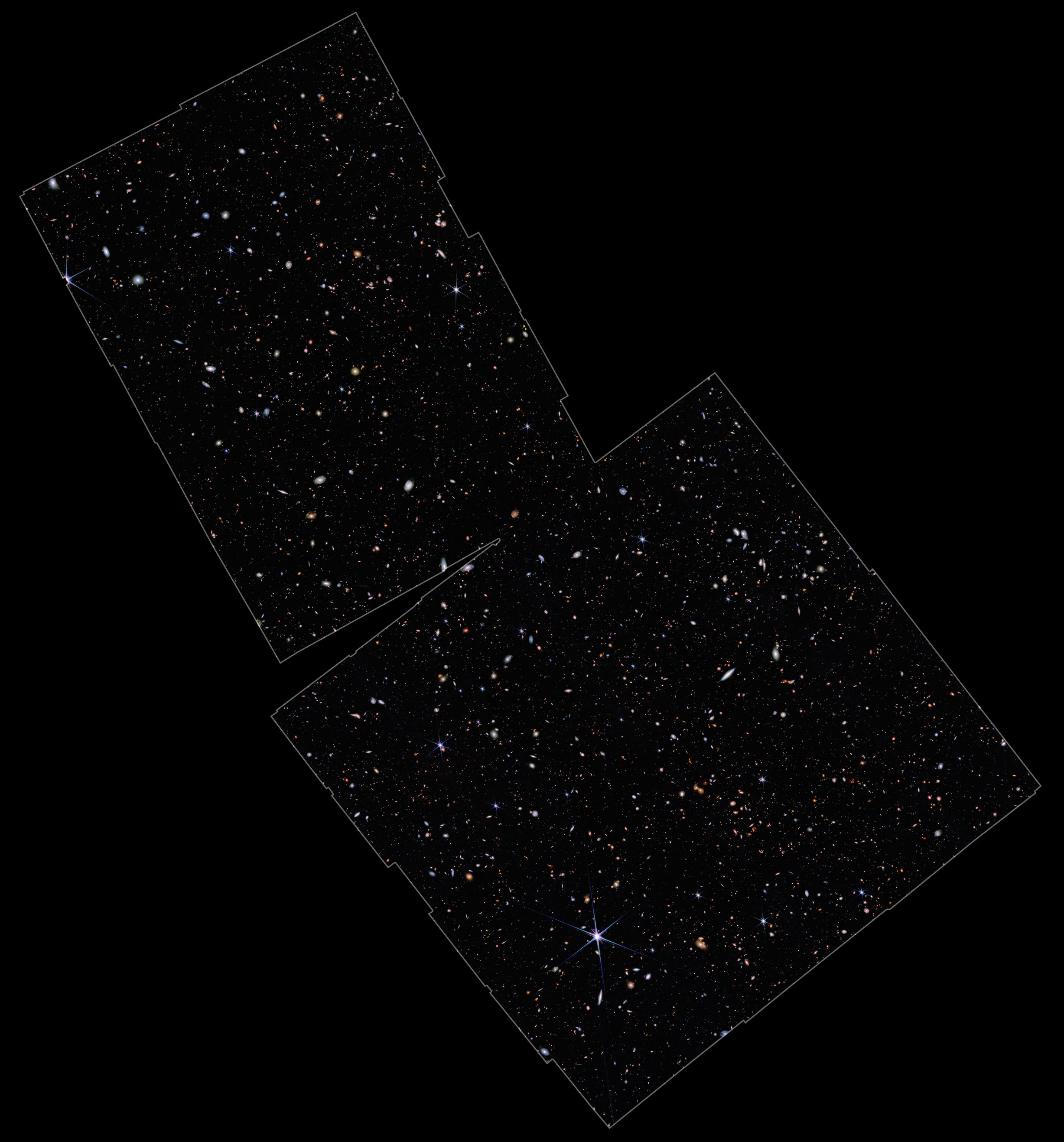
JWST's JADES first deep field image (December 2022) — showing thousands of galaxies at extreme distances in infrared light. This single patch of sky reveals galaxies that should look very different if the Big Bang model's timeline is correct. Credit: NASA, ESA, CSA, M. Zamani (ESA/Webb). Public domain.
What astronomers did not expect was this: the galaxies JWST revealed at the farthest distances look shockingly similar to nearby galaxies. That observation — apparently small and unremarkable — turns out to crack the foundation of the standard Big Bang cosmological model.
Part II: The Big Bang Model and What It Predicts
The Standard Story
The Big Bang model — technically called the ΛCDM model (Lambda-Cold Dark Matter) — is the dominant view in secular cosmology. It holds that:
- The universe began roughly 13.8 billion years ago in a singularity.
- Space itself has been expanding ever since.
- The redshift of distant galaxies (their light stretched to longer, redder wavelengths) is caused by this expansion of space.
- Therefore, galaxies we see at high redshifts are genuinely far away in both space and time — we are seeing them as they were billions of years ago, when the universe was young.
Under this framework, the mathematics predict something strange: an angular size reversal. Let's unpack what that means in plain language.
The Magnification Effect — The Big Bang's Strange Prediction
Normally, the farther away something is, the smaller it looks. A car at 100 meters looks bigger than a car at 1,000 meters. This is intuitive.
But in an expanding universe, the mathematics break that intuition for very distant objects. According to the Big Bang's own equations, galaxies should appear to get smaller with increasing distance only up to a certain point — a redshift of about z = 1.6 (a specific measure of how stretched their light is). Beyond that critical distance, the Big Bang model predicts that galaxies should start to look larger again, even as they get farther away.
This is called the angular diameter magnification effect, and it is a direct consequence of the FLRW metric (the mathematical framework of the Big Bang, named after Friedmann, Lemaître, Robertson, and Walker).
The Big Bang model predicts that past a certain distance, galaxies should appear to grow larger as they get farther away. This is not observed. Not even close.
Part III: What JWST Actually Found
When the JWST began returning data on galaxies at redshifts far beyond z = 1.6 — some at z = 10, 12, even 15 and beyond — astronomers using the standard model expected to see larger-looking galaxies. Instead, they found the exact opposite: distant galaxies keep getting smaller with distance, exactly as if the universe were a plain, non-expanding space governed by ordinary geometry.
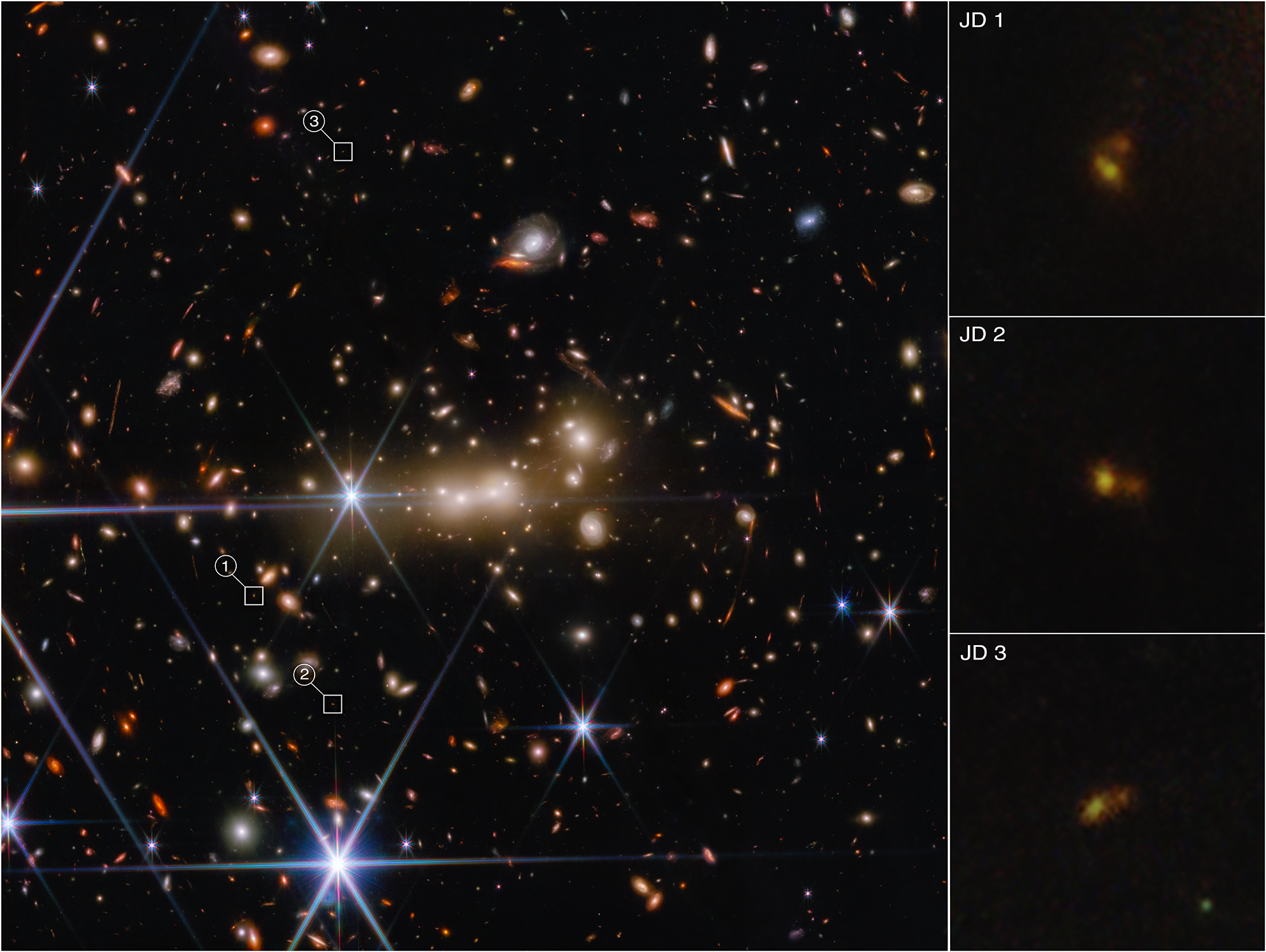
Galaxy cluster MACS J0647 imaged by JWST's NIRCam. The massive cluster acts as a gravitational lens, magnifying light from a much more distant background galaxy (MACS0647-JD, shown in inset boxes). This distant galaxy at high redshift appears tiny — exactly matching the Doppler model prediction, not the Big Bang's magnification effect. Credit: NASA, ESA, CSA, Dan Coe (STScI), Rebecca Larson (UT), Yu-Yang Hsiao (JHU). Image processing: Alyssa Pagan (STScI). CC BY-SA 4.0.
Dr. Lisle compiled data from multiple peer-reviewed JWST studies and plotted the measured angular sizes of hundreds of galaxies against their redshifts. His findings:
- The Big Bang (ΛCDM) prediction does not match the data at high redshifts — not by a little, but by a factor of 5 to 10 times at redshifts beyond 10.
- An alternative model — the Doppler model — matches the data with remarkable precision across all redshift values.
Part IV: Dr. Lisle's Alternative — The Doppler Model
What Is the Doppler Model?
Dr. Jason Lisle proposes that galaxy redshifts are not caused by the expansion of space, but are ordinary Doppler shifts: the same effect that makes an ambulance siren sound higher-pitched as it approaches and lower-pitched as it moves away. In this view:
- Galaxies are moving through space (not carried by expanding space).
- The distance between galaxies increases because the galaxies are moving apart, not because space itself is stretching.
- The universe is not expanding in the FLRW sense — the fabric of space itself is approximately static.
- There was no Big Bang singularity.
This is not a new idea in isolation. What is new is that JWST data now gives us the precision to test it directly — and the Doppler model passes the test while the Big Bang model fails.
Why the Two Models Predict Different Galaxy Sizes
In the Doppler model, the relationship between a galaxy's distance and its apparent angular size is simple: the farther away, the smaller it looks. Always. Without exception. The strange magnification effect of the Big Bang model does not occur because space is not curved in the same way.
Think of it this way:
| Distance | Big Bang (ΛCDM) Prediction | Doppler Model Prediction |
|---|---|---|
| Nearby (z < 0.5) | Smaller as distance increases | Smaller as distance increases |
| Mid-range (z ~ 1.6) | Smallest apparent size | Keeps shrinking |
| Far (z > 1.6) | Gets larger again (magnification) | Keeps shrinking |
| Very far (z = 10–15) | 5–10× larger than Doppler prediction | Matches observed JWST data |
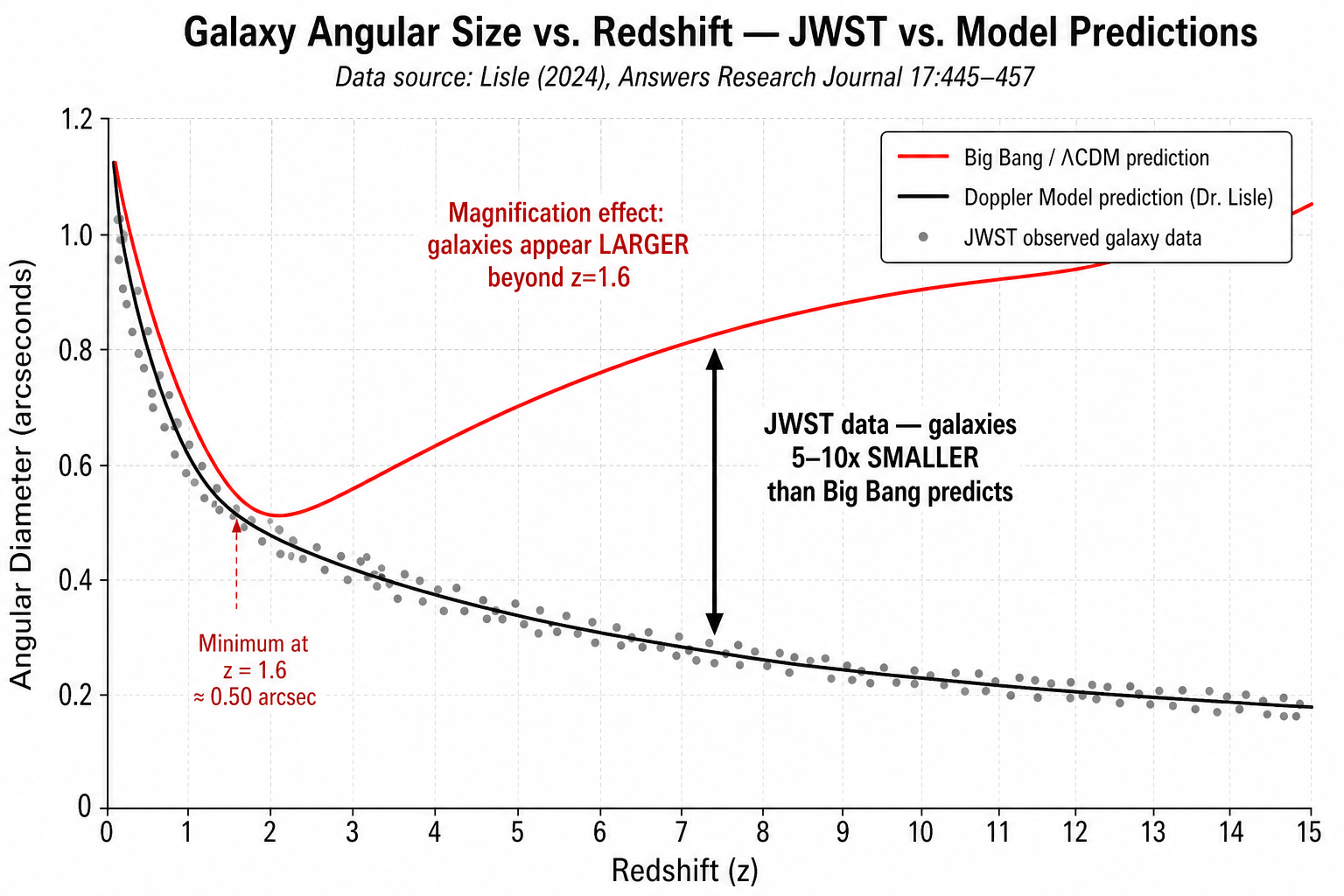
The key diagram from Dr. Lisle's research. The red curve shows what the Big Bang (ΛCDM) model predicts — note how it turns upward after z=1.6, meaning galaxies should appear to grow larger with distance. The black curve shows the Doppler model prediction — always decreasing. The grey dots represent actual JWST galaxy observations. The data follow the Doppler model closely. At z=10–15, the Big Bang predicts galaxies 5–10× larger than what JWST actually sees. Data source: Lisle (2024), Answers Research Journal 17:445–457.
The Doppler model makes one clean, testable prediction: galaxies always look smaller the farther they are. JWST confirms it precisely. The Big Bang model requires galaxies to eventually look larger — and they do not.
Part V: The Tolman Surface Brightness Test
What Is the Tolman Test?
In 1930, physicist Richard Tolman proposed a way to test cosmological models using surface brightness — how bright a galaxy appears per unit of angular area. Different cosmological models make very different predictions about how surface brightness should fade with distance.
- Big Bang (ΛCDM) model predicts: surface brightness should drop by a factor of (1 + z)⁴.
- Doppler model predicts: surface brightness should drop by (1 + z)³.
- Tired light model predicts: surface brightness should drop by (1 + z)¹.
At a redshift of z = 13, this means:
- The ΛCDM model predicts galaxies should be 14 times dimmer in surface brightness than the Doppler model predicts.
- JWST observations match the Doppler model — the galaxies are indeed 14 times brighter in surface brightness than ΛCDM predicted.
The Embarrassing Prior Result
Here is a detail that was already in the data before JWST. In 2001, researchers Lubin and Sandage published a study of the Tolman test using the Hubble Space Telescope. They found that surface brightness dropped by (1 + z)²·⁵⁹ to (1 + z)³·³⁷ — averaging around (1 + z)²·⁹⁸. That is not the (1 + z)⁴ the Big Bang demands. It is precisely the (1 + z)³ the Doppler model predicts.
Their explanation? Galaxy evolution must account for the missing factor. In other words, galaxies must have been intrinsically brighter in the past to make up the difference.
Dr. Lisle's response is direct: you can always invent evolution to patch a failing model. But if galaxy evolution is doing all that work, why do JWST's high-redshift galaxies show no evidence of evolution at all?
The Tolman test was already providing evidence against the Big Bang in 2001. JWST makes that evidence impossible to ignore.
Part VI: The Galaxy Evolution Problem
What Evolution Should Look Like
If the Big Bang is correct and we are seeing galaxies as they were billions of years ago, we should see younger galaxies at high redshift. Young galaxies in the Big Bang model should look different from mature nearby ones:
- Smaller in diameter (they have not grown yet)
- Fewer metals like oxygen, carbon, and iron (these are made in stars over time)
- Less structured — fewer disk galaxies, spiral arms, barred spirals
- Different ratios of galaxy types (more irregulars, fewer spirals)
What JWST Actually Shows
The data from JWST tells the opposite story:
- High-redshift galaxies have comparable sizes to nearby galaxies (in the Doppler model; see above)
- They show comparable metallicity ranges (Rhoads et al. 2023)
- They show mature disk structures and even barred spirals at redshifts above 3 (Ferreira et al. 2022; Costantin et al. 2023)
- The ratio of spiral to elliptical galaxies remains approximately constant out to redshift 10 (Lee et al. 2023)
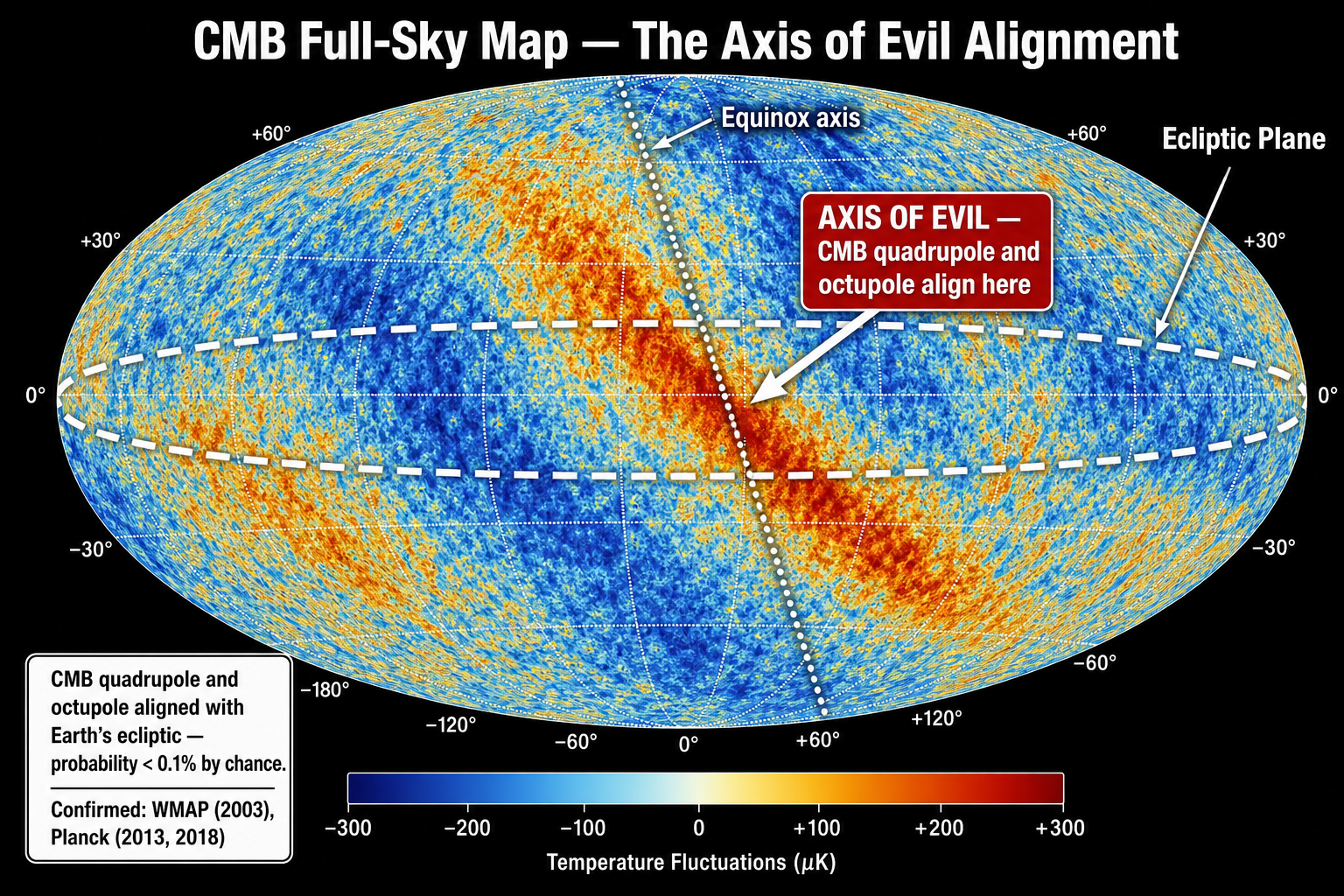
The CMB full-sky temperature map showing the "Axis of Evil" — the unexpected alignment of the CMB's quadrupole and octupole moments with Earth's ecliptic plane (dashed white line). Confirmed by WMAP (2003) and Planck (2013, 2018). The probability of this alignment being coincidental is less than 0.1%. Based on WMAP 9-year data (NASA/WMAP Science Team, public domain).
High-redshift galaxies look like mature, well-formed nearby galaxies in every way that does not depend on which cosmological model you assume. The evidence for billions of years of galaxy evolution is simply absent.
Part VII: Why This Matters for the Big Bang
The Core Problem
The Big Bang model requires galaxy evolution to explain the JWST data. But that evolution:
- Was not predicted before JWST. The models predicted something quite different.
- Would have to be extraordinarily precise — galaxies would need to grow in size and brightness in exactly the right amounts, at every redshift, to eliminate all evidence of the FLRW metric and mimic the Doppler model perfectly.
- Is contradicted by observations that are independent of cosmological assumptions (metallicity, morphology, galaxy type ratios).
As Dr. Lisle writes in his paper:
"Should we expect that galaxies grow in size and in brightness in exactly such a way as to eliminate any evidence of the FLRW metric in favor of simple Doppler shifts? Only by rejecting parsimony could we entertain such a possibility." — Dr. Jason Lisle, Answers Research Journal, 2024
The Parsimony Argument
In science, when two theories both explain the data, the simpler one wins — what is sometimes called Occam's Razor or the principle of parsimony. Here is the comparison:
| Big Bang (ΛCDM) | Doppler Model | |
|---|---|---|
| Free parameters | 3 (H₀, ΩM, ΩΛ) | 1 (H₀ only) |
| Galaxy evolution required? | Yes — and very finely tuned | No |
| Passes angular size test? | No | Yes |
| Passes Tolman brightness test? | No | Yes |
| Passes surface brightness test? | No | Yes |
| Consistent with observed morphology? | Only if evolution is assumed | Yes |
| Consistent with observed metallicity? | Only if evolution is assumed | Yes |
The Doppler model has one adjustable parameter and fits the data without auxiliary hypotheses. The Big Bang model has three adjustable parameters and still requires fine-tuned galaxy evolution to match the same observations.
Part VIII: The Biblical Perspective
Why Dr. Lisle's Work Matters Beyond Science
Dr. Jason Lisle is not merely a cosmologist — he is a creation scientist who takes the biblical text seriously as revelation about the history of the physical world. His Doppler model is explicitly framed as a biblically compatible alternative cosmology.
The implications of his findings for biblical faith are significant:
1. No Big Bang is required. If galactic redshifts are ordinary Doppler shifts in a non-expanding space, there is no mathematical necessity for a singularity 13.8 billion years ago. The universe does not have to have exploded from nothing.
2. No substantial galaxy evolution has occurred. High-redshift galaxies look like nearby galaxies. This is consistent with a universe that was created mature and fully-formed from the beginning.
"By faith we understand that the universe was created by the word of God, so that what is seen was not made out of things that are visible." — Hebrews 11:3
3. Heavy elements in distant galaxies are consistent with biblical creation. The Bible records that water — which contains oxygen — existed before the stars were created (Genesis 1:1–2). The JWST finds metals (heavy elements) in the oldest galaxies accessible to observation, consistent with a universe that was created with chemical complexity from the start.
"In the beginning, God created the heavens and the earth. The earth was without form and void, and darkness was over the face of the deep. And the Spirit of God was hovering over the face of the waters." — Genesis 1:1–2
4. The data resist evolutionary explanations. The more powerful our telescopes become, the more the data resist the deep-time evolutionary narrative and point toward a universe that looks essentially the same at all observable distances.
What Dr. Lisle Predicts
Dr. Lisle makes specific, testable, quantitative predictions that distinguish his model from the Big Bang:
- Galaxies at redshifts beyond z = 15 will have median angular diameters of approximately 0.2 arcseconds (not growing larger as ΛCDM predicts)
- Type Ia supernovae at high redshift will appear approximately 1 magnitude fainter (in absolute terms, as calculated under ΛCDM assumptions) than the standard model expects
- Population III stars — the hypothetical first-generation stars of the Big Bang — will not be found in significant numbers
- Distant galaxies will continue to show mature, structured morphologies with comparable metallicity to nearby galaxies
These are not vague expectations — they are precise, falsifiable numerical predictions. If JWST continues to observe as it has, each result will further validate the Doppler model and further challenge the Big Bang.
Part IX: Common Questions and Objections
Objection: "Isn't the Big Bang supported by overwhelming scientific consensus?"
Response: Scientific consensus is not the same as scientific truth. The history of science is filled with paradigm shifts where majority opinion was wrong. More importantly, consensus does not override empirical data. When observations consistently fail to match a model's predictions — especially by factors of 5 to 10 — the model must be revised or replaced. The JWST data represent exactly that kind of challenge. The Big Bang community is aware of these tensions (see Boylan-Kolchin 2023, published in Nature Astronomy) — secular astronomers themselves are describing these findings as "stress tests" for ΛCDM.
Objection: "Can't galaxy evolution just explain the size differences?"
Response: This is the standard rescue. But notice three problems: (1) The magnitude of evolution required was not predicted by Big Bang galaxy formation models — it is an ad hoc patch after the data came in. (2) The evolution would have to be precisely calibrated to exactly mimic Doppler model predictions at every redshift — an enormous coincidence. (3) Observations that are independent of cosmological models (metallicity, morphology, galaxy type ratios) show no evidence of evolution. You cannot appeal to evolution as a patch in some tests while the data it produces shows no trace of the same evolution in others.
Objection: "The Doppler model sounds like the discredited 'tired light' theory."
Response: They are different models. The tired light hypothesis (Zwicky 1929) proposes that photons lose energy gradually as they travel, with galaxies approximately stationary. It fails the Tolman test badly — predicting surface brightnesses nearly 200 times greater than observed at high redshifts. The Doppler model proposes that galaxies are genuinely moving through space and their redshifts are relativistic Doppler shifts. It passes the Tolman test, the angular diameter test, and the brightness test. The tired light model cannot be confused with the Doppler model.
Objection: "Doesn't the cosmic microwave background (CMB) prove the Big Bang?"
Response: The CMB is real, and it genuinely requires explanation. But it does not straightforwardly prove the Big Bang — because the Big Bang itself faces a deep, unresolved crisis in explaining the CMB, one it can only patch with an ad hoc mechanism it cannot directly test.
The horizon problem — the Big Bang's CMB crisis
The observable universe is approximately 93 billion light-years in diameter, yet it is only 13.8 billion years old. Since light can only travel 13.8 billion light-years in 13.8 billion years, opposite ends of the CMB sky have never been in causal contact. No signal, heat exchange, or physical interaction of any kind could have ever connected them. Yet the CMB temperature across the entire sky is uniform to 1 part in 100,000. How did regions that could never have touched reach the same temperature?
This is called the horizon problem, and it is one of the most embarrassing failures of the raw Big Bang model. The standard answer is cosmic inflation — a hypothetical period of exponential expansion in the first 10⁻³² seconds of the universe, during which space expanded faster than light. The claim is that a tiny causally-connected region was stretched to cosmological scales before the CMB formed, explaining its uniformity.
But inflation is not a solution — it is a patch:
- It has never been directly observed and may be fundamentally untestable
- It requires extreme fine-tuning of its own initial conditions (the inflaton field, its potential, its starting value)
- It was invented specifically to rescue the Big Bang from the horizon problem — a classic ad hoc move
- There are now over 200 competing inflation models, none definitively supported over the others
- Primordial gravitational waves predicted by inflation (B-mode polarization) have not been detected despite dedicated searches (BICEP/Keck)
In other words, both models — the Big Bang and any creation alternative — face a light travel time problem. The difference is that the Big Bang's solution (inflation) is an unobserved, untestable, highly fine-tuned auxiliary hypothesis bolted onto the model after the problem was identified. Creation models address the same problem from several different directions, none of which require the same level of special pleading.
The CMB has additional anomalies the Big Bang cannot explain cleanly
Even granting inflation, the standard model struggles with several CMB features:
The "Axis of Evil" — Earth in a privileged position
The most striking CMB anomaly is the Axis of Evil, named — sarcastically — by secular cosmologists Kate Land and João Magueijo (Physical Review Letters, 2005). When the CMB's largest-scale temperature patterns are mapped, the quadrupole and octupole moments are unexpectedly aligned with:
- The plane of the ecliptic — Earth's orbital plane around the Sun
- The equinoxes — Earth's rotational orientation
The entire Big Bang framework rests on the cosmological principle — the philosophical assumption that the universe is homogeneous and isotropic with no preferred position or direction. This is not an observational result; it is a foundational assumption of the FLRW metric. The Axis of Evil directly violates it. The probability of this alignment being coincidental is estimated at less than 0.1%.
Crucially, this was not a WMAP calibration error. The European Space Agency's Planck satellite — the most precise CMB instrument ever built — confirmed the alignment in 2013 and again in its final 2018 data release. Twenty years of attempts to explain it as instrumental error, foreground contamination, or statistical noise have failed.
The only explanations available are: (1) a staggering coincidence, (2) a systematic error in every CMB instrument ever built, or (3) Earth occupies a cosmologically privileged position in the universe. The secular establishment cannot accept option 3 without dismantling the cosmological principle — which is load-bearing for the entire standard model.
Genesis describes Earth as the first thing God creates and the center of his creative purpose. The stars and heavens are made for the inhabitants of Earth (Genesis 1:14–18). The Axis of Evil is the CMB — confirmed by the most precise space telescope ever pointed at it — telling us that the largest observable structure in the universe is oriented with respect to where we are standing. That is not what an accidental, centerless universe should look like.
"The heavens declare the glory of God, and the sky above proclaims his handiwork." — Psalm 19:1
The "Axis of Evil" is not a fringe claim — it is a Planck-confirmed anomaly that secular cosmology has failed to explain for twenty years. The CMB's largest-scale structure is aligned with Earth's position. The cosmological principle says this should be impossible. Genesis says it makes perfect sense.
Additional CMB tensions
- The low quadrupole anomaly: the CMB has far less large-scale power than ΛCDM predicts.
- The Hubble tension: the value of H₀ derived from the CMB disagrees by 4–5σ with the value measured from local distance indicators — one of the most serious unsolved problems in modern cosmology, suggesting the standard model is internally inconsistent.
What creation science offers — ranked by current evidential strength
Creation scientists have developed several cosmological frameworks addressing the CMB and the light travel problem. Importantly, these are not all equally supported — and intellectual honesty requires ranking them accordingly rather than presenting them as a uniform front.
1. Dr. Jason Lisle — Anisotropic Synchrony Convention (ASC) — currently the strongest answer. Lisle (2010) identifies that the light travel time problem is not a physical problem at all — it is an artifact of a synchrony convention. Einstein's relativity only ever measures the round-trip speed of light. The one-way speed is mathematically underdetermined and is set by a definitional choice called a synchrony convention. The standard assumption (Einstein Synchrony Convention, ESC) assigns equal speeds to both directions. The ASC instead treats the one-way speed of light toward the observer as effectively instantaneous upon arrival. Under ASC, when God creates the stars on Day 4, their light arrives at Earth on Day 4 — not because anything travels faster than light, but because of how "simultaneous" is defined. No new physics is required, no fine-tuning, no untestable mechanism. The same physical universe produces the same observational predictions under either convention. The light travel time "problem" evaporates entirely. This is not sleight of hand — it is a rigorous application of special relativity's treatment of simultaneity, which Einstein himself acknowledged was a matter of convention (Einstein 1905, §1). ASC is currently the most logically airtight framework available in creation cosmology.
2. Dr. John Hartnett — Carmeli Cosmology — serious but the author has largely moved on. Hartnett applied Moshe Carmeli's 5-dimensional cosmological general relativity, which treats cosmic expansion as an additional dimension. This framework produces CMB acoustic peak predictions and galaxy rotation curves without dark matter, dark energy, or inflation — a genuinely impressive result. However, Hartnett himself has substantially revised his position in more recent years and has moved closer to ASC-type thinking as his primary framework. The Carmeli approach remains historically and scientifically noteworthy, but should not be presented as a currently defended live model without that caveat.
3. Dr. Russell Humphreys — White Hole Cosmology (Starlight and Time, 1994) — historically significant, now largely set aside by its own author. Humphreys proposed that the universe began as a finite bounded mass that expanded through a white hole phase, with Earth near the center. Gravitational time dilation under general relativity would permit billions of years to pass at the cosmic boundary while only thousands of years elapsed near Earth. The CMB uniformity would be explained by genuine thermalization at the outer boundary. This was an important and creative proposal — the first rigorous YEC cosmological model — but other creation scientists (including Danny Faulkner) identified significant technical problems with the time dilation mechanics during the expansion phase, and Humphreys himself acknowledged these and has been revising the model for years. It should be recognized for what it was: a pioneering attempt, not a settled answer.
4. Mature creation — theologically coherent, not a scientific model. On the analogy of Adam being created as a mature adult (Genesis 2:7) and the wine at Cana being created with apparent age (John 2:9–10), God may have created the universe with the CMB already present as part of the initial conditions — radiation in an already-thermalized state with apparent depth. This is a valid theological boundary condition and cannot be falsified. Most creation scientists treat it as a last resort rather than a primary scientific answer, but it remains coherent and non-contradictory.
An honest summary of where things stand
The most defensible combination currently available is ASC + the Doppler model: ASC dissolves the light travel time problem at the philosophical level without requiring new physics, and the Doppler model provides quantitative predictions about galaxy angular sizes and brightnesses that match JWST data better than ΛCDM. Neither model fully explains why the CMB has its specific temperature (~2.725 K) and fluctuation spectrum — that remains open work in creation cosmology. But the same is true of the Big Bang without inflation, which is itself unobserved and untested. Both sides have genuine work to do. Only one side requires a speculative, unfalsifiable rescue mechanism as its primary load-bearing answer.
The bottom line: the CMB does not prove the Big Bang. It proves that the universe has a thermal radiation background that requires explanation. The Big Bang requires an unobserved inflationary epoch with extreme fine-tuning to supply that explanation. ASC dissolves the problem at its root by correctly identifying it as definitional rather than physical.
The light travel time problem dissolves entirely under ASC because the one-way speed of light is not a physical fact but a synchrony convention — a point Einstein himself acknowledged in 1905. The Big Bang's answer to the same problem (inflation) is an unobserved, unfalsifiable, 200-version hypothesis. The comparison is not even close.
Part X: Summary — What the Data Show
| Test | Big Bang (ΛCDM) | Doppler Model |
|---|---|---|
| Galaxy angular size vs. redshift | Fails — predicts magnification not seen | Passes — matches data at all redshifts |
| Tolman surface brightness test | Fails — off by factor of (1 + z) | Passes — matches (1 + z)³ drop |
| Galaxy brightness vs. redshift | Fails — requires unpredicted evolution | Passes — slight dimming matches data |
| Galaxy morphology at high-z | Fails — predicts young irregular galaxies | Passes — mature structures observed |
| Galaxy metallicity at high-z | Fails — predicts metal-poor early galaxies | Passes — comparable metallicity found |
| Predictive simplicity | 3 parameters + galaxy evolution | 1 parameter, no evolution needed |
| Consistency with biblical creation | Contradicts Genesis timeline | Consistent with young, created universe |
Key Verses for Further Reflection
- Job 26:7 — "He stretches out the north over the void and hangs the earth on nothing." — The Bible describes cosmic structure without requiring a Big Bang origin.
- Genesis 1:1 — "In the beginning, God created the heavens and the earth." — Creation is an act of divine will, not an unguided explosion from a singularity.
- Isaiah 40:22 — "He who sits above the circle of the earth... who stretches out the heavens like a curtain and spreads them like a tent to dwell in." — The stretching of the heavens may describe galactic recession in created, non-FLRW space.
- Psalm 19:1 — "The heavens declare the glory of God, and the sky above proclaims his handiwork." — Astronomy's function in Scripture is doxological — the stars exist to point to the Creator.
- Hebrews 11:3 — "By faith we understand that the universe was created by the word of God, so that what is seen was not made out of things that are visible." — Biblical cosmology begins with revealed creation ex nihilo, not with naturalistic extrapolation.
Primary Texts Index
| Passage | Relevance |
|---|---|
| Genesis 1:1–2 | Creation of heavens and earth; water precedes stars |
| Genesis 1:14–19 | Stars created on Day 4; supports young universe |
| Job 26:7 | Cosmic hanging; non-naturalistic cosmology |
| Psalm 19:1 | Heavens declare Creator's glory |
| Isaiah 40:22, 26 | God stretches heavens; names every star |
| Hebrews 11:3 | Universe made from nothing by God's word |
| Revelation 21:1 | New heavens and new earth — present order temporary |
References
All peer-reviewed citations are from Dr. Lisle's original paper unless otherwise noted.
Primary Source
Lisle, Jason. "Sizes of Galaxies in JWST Data Suggest New Cosmology." Answers Research Journal 17 (2024): 445–457. https://answersresearchjournal.org/cosmology/jwst-data-suggest-new-cosmology/
Supporting Scientific Literature
Atek, Hakim, et al. 2023. "Revealing Galaxy Candidates out to z~16 With JWST Observations of the Lensing Cluster SMACS0723." Monthly Notices of the Royal Astronomical Society 519, no. 1 (February): 1201–1220.
Austin, Duncan, et al. 2023. "A Large Population of Faint 8 < z < 16 Galaxies Found in the First JWST NIRCam Observations of the NGDEEP Survey." The Astrophysical Journal Letters 952, no. 1: L7.
Boylan-Kolchin, Michael. 2023. "Stress Testing ΛCDM With High-Redshift Galaxy Candidates." Nature Astronomy 7 (13 April): 731–735. (Note: A secular publication acknowledging Big Bang model tensions with JWST data.)
Choudhury, T. R., and T. Padmanabhan. 2005. "Cosmological Parameters From Supernova Observations: A Critical Comparison of Three Data Sets." Astronomy and Astrophysics 429 (5 January): 807–818.
Costantin, Luca, et al. 2023. "A Milky Way-Like Barred Spiral Galaxy At a Redshift of 3." Nature 623, no. 7987 (16 November): 499–501.
Dennis, Phillip W. 2022. "Mach's Principle in General Relativity and Reduced Light Travel Times in Cavitated Cosmologies." Answers Research Journal 15 (October 26): 339–357. https://answersresearchjournal.org/machs-principle-in-general-relativity-and-reduced-light-travel-times-in-cavitated-cosmologies/
De Sitter, W. 1917. "On Einstein's Theory of Gravitation and its Astronomical Consequences. Third Paper." Monthly Notices of the Royal Astronomical Society 78, no. 1 (November): 3–28.
Ferreira, Leonardo, et al. 2022. "Panic! At the Disks: First Rest-Frame Optical Observations of Galaxy Structure at z > 3 With JWST In the SMACS 0723 Field." The Astrophysical Journal Letters 938, no. 1 (October 10): L2.
Goldhaber, G., et al. 2001. "Timescale Stretch Parameterization of Type Ia Supernova B-Band Light Curves." The Astrophysical Journal 558, no. 1 (September 1): 359–368.
Gupta, Rajendra. 2023. "JWST Early Universe Observations and ΛCDM Cosmology." Monthly Notices of the Royal Astronomical Society 524, no. 3 (September): 3385–3395.
Harikane, Yuichi, et al. 2023. "A Comprehensive Study of Galaxies at z~9–16 Found in the Early JWST Data: Ultraviolet Luminosity Functions and Cosmic Star Formation History at the Pre-reionization Epoch." The Astrophysical Journal Supplement Series 265, no. 1 (March): 5.
Hartnett, John C. 2015. "Speculation on Redshift in a Created Universe." Answers Research Journal 8 (February 11): 77–85. https://answersresearchjournal.org/speculation-redshift-created-universe/
Hogg, David W. 2000. "Distance Measures in Cosmology." arXiv e-prints. https://arxiv.org/abs/astro-ph/9905116
Ito, Kei, et al. 2023. "Size–Stellar Mass Relation and Morphology of Quiescent Galaxies at z ≥ 3 in Public JWST Fields." arXiv:2307.06994v1.
Labbé, Ivo, et al. 2023. "A Population of Red Candidate Massive Galaxies ~600 Myr After the Big Bang." Nature 616, no. 7956 (13 April): 266–269.
Lee, Jeong Hwan, et al. 2023. "Morphology of Galaxies In JWST Fields: Initial Distribution and Evolution of Galaxy Morphology." arXiv:2312.04899v2.
Leibundgut, B., et al. 1996. "Time Dilation in the Light Curve of the Distant Type Ia Supernova SN 1995K." The Astrophysical Journal 466, no. 1 (July 20): L21–L24.
Lisle, Jason. 2016. "New Method to Assess the Luminosity Function of Galaxies." Answers Research Journal 9 (March 30): 67–80. https://answersresearchjournal.org/method-assess-luminosity-function-galaxies/
Lisle, Jason. 2018. The Physics of Einstein: Black Holes, Time Travel, Distant Starlight, E = mc². Dallas, Texas: Biblical Science Institute.
Lisle, Jason. 2022. "The James Webb Space Telescope." January 21. Biblical Science Institute. https://biblicalscienceinstitute.com/astronomy/the-james-webb-space-telescope/
Lovyagin, Nikita, et al. 2022. "Cosmological Model Tests with JWST." Galaxies 10, no. 6 (December): 108.
Lubin, Lori M., and Allan Sandage. 2001. "The Tolman Surface Brightness Test for the Reality of the Expansion. IV. A Measurement of the Tolman Signal and the Luminosity Evolution of Early-Type Galaxies." The Astronomical Journal 122, no. 3 (September 1): 1084–1103.
Morishita, Takahiro, et al. 2023. "Enhanced Sub-kpc Scale Star-formation: Results From A JWST Size Analysis of 341 Galaxies At 5 < z < 14." arXiv:2308.05018v2.
Ono, Yoshiaki, et al. 2023. "Morphologies of Galaxies at z ≳ 9 Uncovered by JWST/NIRCam Imaging: Cosmic Size Evolution and an Identification of an Extremely Compact Bright Galaxy at z ~ 12." The Astrophysical Journal 951, no. 1: 72.
Rhoads, James E., et al. 2023. "Finding Peas in the Early Universe with JWST." The Astrophysical Journal Letters 942, no. 1: L14.
Rybicki, George B., and Alan P. Lightman. 1979. Radiative Processes in Astrophysics. Hoboken, New Jersey: John Wiley and Sons.
Tacchella, Sandro, et al. 2023. "JWST NIRCam + NIRSpec: Interstellar Medium and Stellar Populations of Young Galaxies With Rising Star Formation and Evolving Gas Reservoirs." Monthly Notices of the Royal Astronomical Society 522, no. 4 (July): 6236–6249.
Tolman, Richard C. 1930. "On the Estimation of Distances in a Curved Universe with a Non-Static Line Element." Proceedings of the National Academy of Sciences 16, no. 7 (July 15): 511–520.
Trujillo, Ignacio, et al. 2004. "The Luminosity-Size and Mass-Size Relations of Galaxies Out to z ~ 3." The Astrophysical Journal 604, no. 2: 521–533.
Wilson, O. C. 1939. "Possible Applications of Supernovae to the Study of the Nebular Red Shifts." Astrophysical Journal 90: 634–636.
Yang, L., et al. 2022. "Early Results from GLASS-JWST. V: The First Rest-frame Optical Size–Luminosity Relation of Galaxies at z > 7." The Astrophysical Journal Letters 938, no. 2: L17.
Zwicky, F. 1929. "On the Red Shift of Spectral Lines through Interstellar Space." Proceedings of the National Academy of Sciences 15, no. 10 (October 15): 773–779.
About the Researcher
Dr. Jason Lisle holds a Ph.D. in Astrophysics from the University of Colorado. He is the founder and director of the Biblical Science Institute and a prolific creation scientist and author. His books include The Physics of Einstein (2018) and Taking Back Astronomy. He has published multiple peer-reviewed papers in the Answers Research Journal and writes regularly at biblicalscienceinstitute.com. His work in cosmology represents the most rigorous quantitative creation-based alternative to Big Bang cosmology currently available.
The views expressed in Dr. Lisle's original paper are those of the author and are not necessarily those of the ARJ Editor or Answers in Genesis.