🌌 Three Lines of Evidence That Point to a Created Universe
TypeScience Overview — Creation Cosmology Synthesis
Central ClaimThree independent lines of modern astronomical evidence — JWST galaxy data, the CMB Axis of Evil, and the Anisotropic Synchrony Convention — converge on the same conclusion: the universe fits a created, Earth-centered, young-universe framework better than the Big Bang model, and the secular establishment's responses to each require untestable, ad hoc rescue mechanisms that the data do not support.
"In the beginning, God created the heavens and the earth." — Genesis 1:1
"Lift your eyes and look to the heavens: Who created all these? He who brings out the starry host one by one and calls forth each of them by name." — Isaiah 40:26
Why This Matters
Modern cosmology presents itself as settled science. The Big Bang happened 13.8 billion years ago. The universe is 93 billion light-years across. Earth is an unremarkable speck on the arm of an average galaxy among hundreds of billions. There is no center, no edge, no preferred direction, no Creator.
But three separate lines of observational evidence now challenge that picture. We begin, openly, from a biblical presupposition — that Genesis is true history and the universe is the work of a Creator. Secular cosmologists begin from their own presupposition: that nature is all there is, that the universe has no center and no purpose, and that no Creator exists. Neither starting point is neutral. The question worth asking is not "who has a presupposition" — everyone does — but which presupposition is confirmed when the data arrives? Each of the three lines below comes from different instruments, different measurements, and different research groups. Each points in the same direction: toward a created, structured, Earth-oriented universe.
This page is the accessible overview. Each section links to deeper reading for those who want the technical detail.
Line 1 — JWST Galaxy Data Breaks the Big Bang's Predictions
The prediction the Big Bang cannot escape
The Big Bang model predicts that space itself is expanding. This produces a specific, testable consequence: beyond a certain distance (redshift z = 1.6), galaxies should appear to get larger as they get farther away — a "magnification effect" baked into the mathematics of the expanding universe model.
This is not a minor prediction. It is a direct consequence of the FLRW metric, the mathematical foundation of the entire Big Bang cosmology.
What the James Webb Space Telescope actually found
When JWST began returning images of galaxies at redshifts of 10, 12, and 15, the magnification effect was not there. Distant galaxies keep getting smaller with increasing distance — exactly as ordinary geometry in non-expanding space would predict. The discrepancy between the Big Bang prediction and the observed galaxy sizes is a factor of 5 to 10 times at the highest redshifts.
Dr. Jason Lisle (Ph.D. Astrophysics, University of Colorado) published a peer-reviewed analysis showing that a Doppler model — in which galaxies move through a non-expanding space and their redshifts are ordinary relativistic Doppler shifts — matches the data at all redshifts without any auxiliary assumptions. The Big Bang model only matches the data if galaxies underwent precisely calibrated size and brightness evolution over billions of years — evolution that, tellingly, leaves no trace in the other properties of those same galaxies (their metallicity, structure, and morphology all look identical to nearby galaxies).
What the secular response reveals
The standard response is "galaxy evolution." Galaxies were smaller in the past and grew over time. But:
- This evolution was not predicted before JWST — it is a patch invented after the discrepancy appeared
- It would have to be precisely calibrated to mimic Doppler model predictions at every redshift value
- The same galaxies that are supposedly 5–10× smaller show the same metallicity, disk structure, spiral arms, and barred spiral morphology as nearby galaxies — zero evidence of youth
When a model requires finely tuned, unpredicted, and unobserved evolution to survive contact with every new data set, the question is not whether to patch it — it is whether the underlying model is correct.
The JWST found a universe that looks the same at every distance. The Big Bang requires it to look very different at high redshifts. The Doppler model — consistent with a created, non-Big-Bang universe — matches the data precisely.
For full technical detail: JWST Galaxies Challenge the Big Bang — Dr. Lisle's New Cosmology
Line 2 — The CMB "Axis of Evil" Shows Earth Has a Special Position
The Big Bang's foundational assumption
The entire Big Bang framework rests on the cosmological principle: the universe is homogeneous and isotropic — it looks the same in all directions from all positions. There is no center, no edge, no preferred direction. This is not derived from observation. It is a philosophical assumption embedded in the mathematics of the standard model from the start.
Remove it, and the FLRW metric — the mathematical basis of the Big Bang — loses its justification.
What the CMB actually shows — and what the image above means
The Cosmic Microwave Background (CMB) is a faint glow of microwave radiation detected in every direction in the sky. Think of it as a photograph of the entire universe taken from Earth, with the colors showing tiny temperature differences — blue is slightly cooler, red is slightly warmer. The variations are incredibly small (less than one ten-thousandth of a degree), but they form patterns across the sky.
The image above is that full-sky photograph, stretched into an oval so the whole sky fits on one page — like unfolding a globe into a flat map.
Here is the critical thing to understand about the patterns in that image.
Physicists decompose the CMB's temperature ripples into "modes" — similar to how a musical chord can be broken into individual notes. The two biggest modes are:
- The quadrupole — the four largest lobes of warm and cool across the whole sky (imagine dividing the sky into four alternating regions)
- The octupole — the next size down, eight lobes
In a universe with no center and no preferred direction — which is exactly what the Big Bang assumes — these lobes should point in completely random orientations. There is no reason the biggest temperature waves in the universe should have anything to do with Earth's location or the plane of Earth's orbit around the Sun.
But they do. The axes of both the quadrupole and the octupole align with each other (already improbable on its own) AND they align with the ecliptic plane — the flat disk traced out by Earth's orbit around the Sun — marked by the white dashed line in the image. They also align with the equinoxes — the direction Earth faces at the start of spring and autumn.
In plain language: the universe's largest-scale temperature structure is oriented with respect to where Earth is and how Earth is oriented. The biggest pattern in the observable universe appears to "know" about our planet.
Secular cosmologists Kate Land and João Magueijo published this finding in Physical Review Letters (2005) and named it the "Axis of Evil" — sarcastically, because it was so cosmologically inconvenient. The probability of this alignment being a random coincidence is less than 0.1%.
This was not an instrument error. The European Space Agency's Planck satellite — the most precise CMB instrument ever built — confirmed the alignment in 2013 and again in its final 2018 data release. Twenty years of attempts to explain it away have failed.
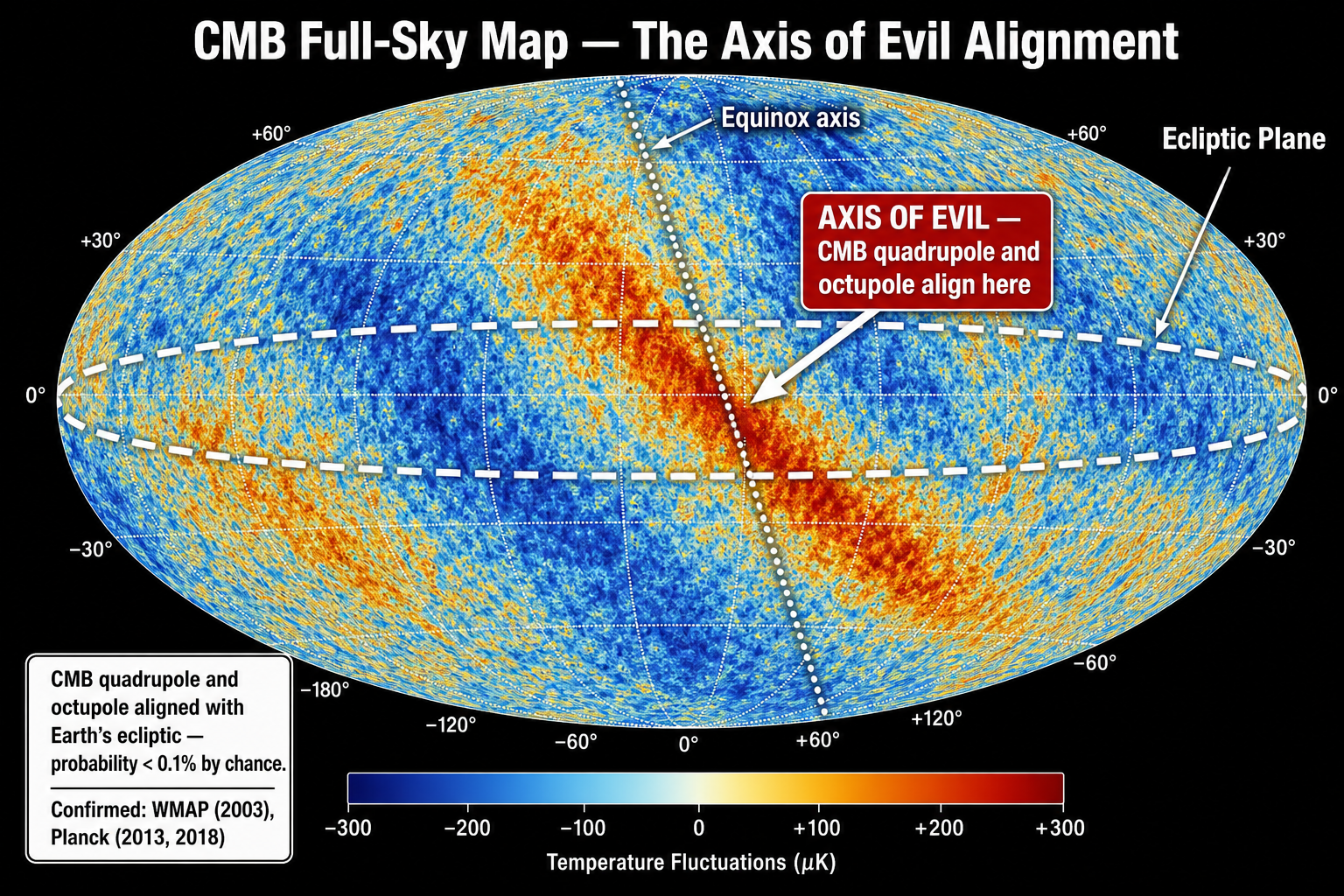
The full-sky CMB temperature map. Blue = slightly cooler, red/orange = slightly warmer. The white dashed line is the ecliptic plane — the flat plane of Earth's orbit around the Sun. The universe's dominant temperature patterns (quadrupole and octupole) align with this line at less than 0.1% probability by chance. Confirmed by WMAP (2003) and Planck (2013, 2018). Based on WMAP 9-year data, NASA/WMAP Science Team, public domain.
What this means
There are only three possible explanations:
| Explanation | Status |
|---|---|
| Random coincidence | Probability < 0.1%; Planck-confirmed twice |
| Systematic instrument error | Ruled out across multiple independent missions |
| Earth occupies a cosmologically privileged position | Consistent with the data; fatal to the cosmological principle |
The cosmological principle says option 3 is impossible. The data says option 3 is what the sky looks like.
Genesis 1 describes Earth as the first thing God creates, the center of his creative work, and the location for which the heavens are made (Genesis 1:14–18 — the sun, moon, and stars are made for Earth's inhabitants). The CMB's largest-scale structure is oriented with respect to Earth's position and orbital plane. These two statements are consistent.
The most expensive CMB mission ever built confirmed that the universe's largest-scale structure is aligned with Earth. The Big Bang's foundational assumption says this should be impossible. Genesis 1 says it makes perfect sense.
Additional CMB tensions the standard model cannot resolve:
- The horizon problem: the CMB is uniform across a 93-billion-light-year sky, but regions on opposite sides have never been in causal contact. The Big Bang's rescue — cosmic inflation — is unobserved, untested, and exists in over 200 competing versions.
- The low quadrupole anomaly: the CMB has less large-scale power than ΛCDM predicts.
- The Hubble tension: the value of the Hubble constant derived from the CMB disagrees with local measurements by 4–5 standard deviations — suggesting the model is internally inconsistent.
Line 3 — The Distant Starlight Problem Has a Rigorous Solution the Big Bang Cannot Match
The problem both sides face
If the universe is only thousands of years old, how does light from stars billions of light-years away reach us? This is the distant starlight problem — and it is often presented as a knockout blow against young-universe creation.
What is less often acknowledged: the Big Bang faces an equivalent problem. The CMB is uniform across a 93-billion-light-year universe that is only 13.8 billion years old. Opposite regions could never have been in causal contact. How did they reach the same temperature? This is the horizon problem, and it is the Big Bang's version of the same puzzle.
The difference is in the quality of the proposed solutions.
The Big Bang's answer: cosmic inflation
The Big Bang solves the horizon problem with inflation — a hypothetical period of exponential expansion in the first 10⁻³² seconds, during which space expanded faster than light, stretching a tiny causally-connected region to cosmological scales.
Inflation is:
- Not directly observed — no instrument has detected the inflaton field
- Not uniquely predicted — there are over 200 competing inflation models
- Invented specifically to patch the horizon problem — a textbook ad hoc rescue
- Not confirmed — searches for its predicted signature (primordial gravitational wave B-mode polarization) by BICEP/Keck have not found it
The creation answer: the Anisotropic Synchrony Convention
Dr. Jason Lisle (2010) identified that the distant starlight problem is not a physical problem at all. It is an artifact of a synchrony convention — a definitional choice about how we set clocks.
Einstein's special relativity only measures the round-trip speed of light. The one-way speed — from source to observer — cannot be directly measured without already having synchronized clocks at both ends, which requires sending a light signal, which is circular. Einstein acknowledged in his 1905 paper that clock synchronization by light signals requires a stipulation — his word. The choice of equal one-way speeds in both directions (the Einstein Synchrony Convention, ESC) is a definition, not a discovery.
The Anisotropic Synchrony Convention (ASC) defines the one-way speed of light toward the observer as instantaneous, and the one-way speed away from the observer as c/2, preserving the same round-trip average. Under ASC:
- All observable predictions are identical to ESC — no experiment can distinguish them
- When God creates the stars on Day 4, their light arrives at Earth on Day 4 — by definition, because "simultaneous with the moment of creation" is what ASC's clock convention means
- There is no light travel time problem — it evaporates as a coordinate artifact
Why ASC is not "cheating"
The objection that ASC "sidesteps" the problem misunderstands what is being claimed. It is not that the physics is different — it is that the problem was never physical. The distant starlight "problem" was generated by assuming ESC and then asking why the universe does not match ESC's implications. Switch to ASC and the question does not arise.
Inflation, by contrast, claims to be a physical solution — a real field, a real mechanism, a real event. That is a testable claim. It has been tested. It has not been found.
| Big Bang (Inflation) | ASC | |
|---|---|---|
| Observed? | No | Convention — not a physical claim |
| Testable? | In principle; failed B-mode test | Not applicable — equivalent to ESC in all observables |
| Required new physics? | Yes — inflaton field | No |
| Fine-tuning required? | Yes — extreme | No |
| Competing versions? | 200+ | One |
| Consistent with Einstein 1905? | Assumed, not derived | Explicitly acknowledged by Einstein |
The distant starlight problem and the horizon problem are the same puzzle. Creation's answer (ASC) requires no new physics and is immune to falsification because it makes the same predictions as standard physics. The Big Bang's answer (inflation) requires new unobserved physics and has failed its primary observational test.
How the Three Lines Converge
These are not three separate arguments patched together. They are three independent measurements pointing to the same conclusion:
| Evidence | What it shows | Big Bang response | Creation framework |
|---|---|---|---|
| JWST galaxy sizes | Galaxies always shrink with distance — no magnification | Ad hoc galaxy evolution (unpredicted, unobserved in other properties) | Doppler model matches data at all redshifts |
| CMB Axis of Evil | Universe's largest structure aligned with Earth | Cosmological principle violated — no agreed explanation after 20 years | Earth has a cosmologically privileged position — consistent with Genesis 1 |
| Distant starlight / horizon problem | Both models face light travel time challenges | Cosmic inflation — unobserved, 200+ versions, failed B-mode test | ASC dissolves the problem — no new physics required |
None of these is a proof of biblical creation in the deductive sense. Science does not work that way. What they represent is a pattern: every time modern astronomy reaches a new level of precision, the data fits the creation framework more naturally and requires the Big Bang framework to add another untestable rescue mechanism.
The JWST was supposed to confirm the Big Bang's galaxy evolution predictions. It did the opposite. The Planck satellite was supposed to definitively confirm the cosmological principle. It confirmed the Axis of Evil instead. The BICEP experiment was supposed to detect inflation's signature. It found nothing.
"The heavens declare the glory of God, and the sky above proclaims his handiwork." — Psalm 19:1
The universe is not being silent. The data is speaking. The question is whether we are willing to hear it.
Key Figures in Creation Cosmology
| Researcher | Contribution | Key Work |
|---|---|---|
| Dr. Jason Lisle | Doppler model for galaxy redshifts; Anisotropic Synchrony Convention | Answers Research Journal 17 (2024); The Physics of Einstein (2018) |
| Dr. Russell Humphreys | White Hole Cosmology (pioneering YEC cosmological model, now revised) | Starlight and Time (1994) |
| Dr. John Hartnett | Carmeli cosmology application to CMB and galaxy rotation | Multiple ARJ papers (2000s) |
| Dr. Danny Faulkner | Critical analysis and refinement of YEC cosmological models | Answers Research Journal various |
Further Reading on This Site
- JWST Galaxies Challenge the Big Bang — Dr. Lisle's Full Technical Analysis — the peer-reviewed paper explained in full, with all figures and references
- The Age of the Earth — What the Bible Actually Says — the biblical chronological framework that provides the theological foundation
External References
Lisle, Jason. "Sizes of Galaxies in JWST Data Suggest New Cosmology." Answers Research Journal 17 (2024): 445–457. https://answersresearchjournal.org/cosmology/jwst-data-suggest-new-cosmology/
Lisle, Jason. "Anisotropic Synchrony Convention — A Solution to the Distant Starlight Problem." Answers Research Journal 3 (2010): 191–207.
Land, Kate, and João Magueijo. "The Axis of Evil." Physical Review Letters 95, no. 7 (2005): 071301.
Planck Collaboration. "Planck 2018 Results. VII. Isotropy and Statistics of the CMB." Astronomy & Astrophysics 641 (2020): A7.
Boylan-Kolchin, Michael. "Stress Testing ΛCDM With High-Redshift Galaxy Candidates." Nature Astronomy 7 (2023): 731–735.
Einstein, Albert. "On the Electrodynamics of Moving Bodies." Annalen der Physik 17 (1905): 891–921. §1 (on the definition of simultaneity).
Humphreys, D. Russell. Starlight and Time. Green Forest, Arkansas: Master Books, 1994.